Dynamic Minimum Validator Commission to Improve LUNA Decentralization and Nakamoto Coefficient
Summary
This discussion proposes that the Terra / LUNA community explore a Dynamic Minimum Validator Commission mechanism for Phoenix-1.
The objective is to improve stake distribution, increase the Nakamoto coefficient, and make the chain more attractive to builders, users and long-term ecosystem participants.
This is not a request to immediately change validator commissions. It is a proposal to open a serious community discussion and, if feedback is positive, request the Phoenix Directive or other qualified core contributors to prepare a technical review and possible implementation plan.
Background
Phoenix-1 currently has a 5% minimum validator commission. This ensures validators have at least some income for infrastructure, monitoring, governance participation and chain maintenance.
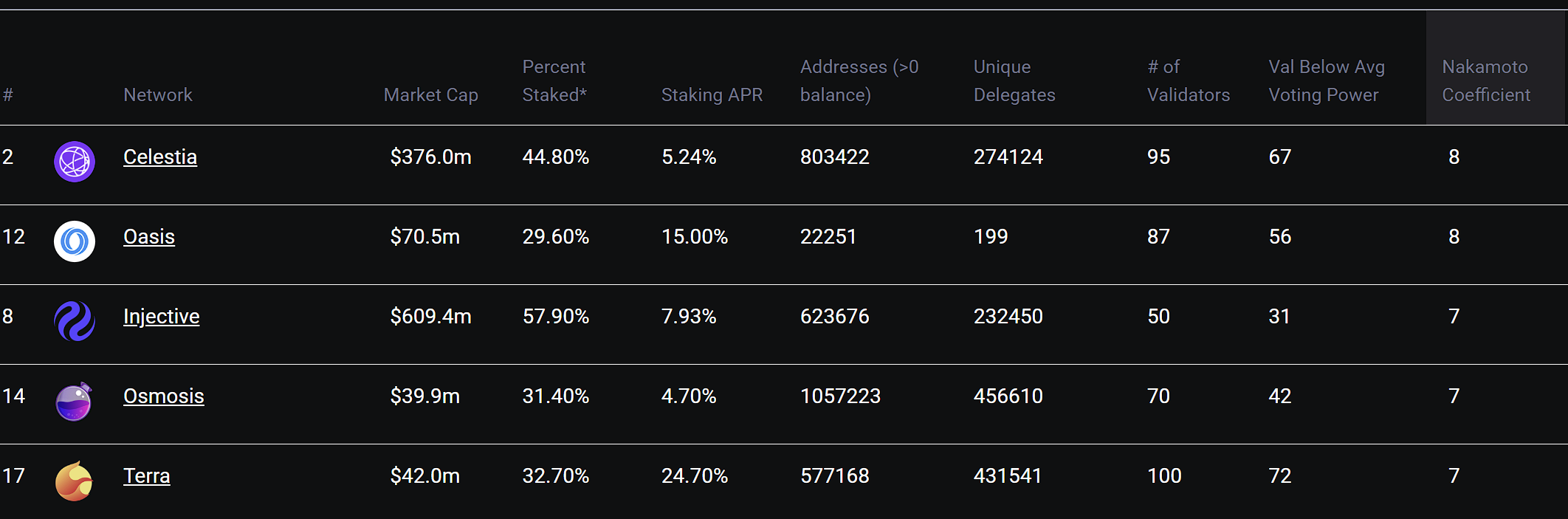
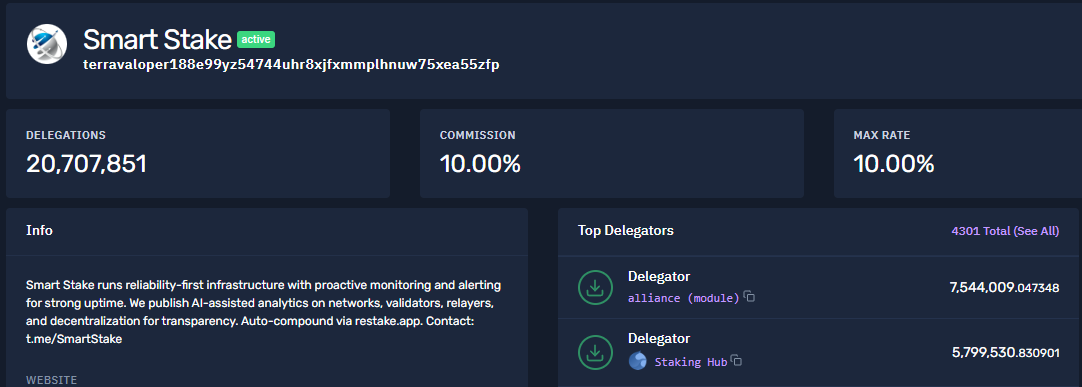
However, the chain still appears to have a meaningful voting-power concentration among the largest validators. In a proof-of-stake network, voting power concentration matters because consensus security, governance influence and chain resilience are directly connected to how stake is distributed.
A low Nakamoto coefficient can create several concerns:
-
It may reduce builder confidence.
-
It may make the chain appear more centralised than it should be.
-
It may increase the influence of a small group of validators over governance and consensus.
-
It may make it harder for smaller validators to attract delegations.
-
It may contradict the long-term objective of decentralisation.
This discussion is based on a simple principle:
The higher a validator’s voting power, the higher their minimum commission should be.
This does not punish successful validators. Instead, it creates an economic nudge that encourages delegators to consider lower-voting-power validators, improving stake distribution across the active set.
Proposal Concept
The community should explore a dynamic minimum commission model where each validator’s minimum commission is linked to its voting power.
The current 5% minimum commission would remain the base floor for all validators.
Validators with higher voting power would have a higher minimum commission, up to a maximum cap, for example 20%.
Example Model
A possible formula could be:
Dynamic Minimum Commission =
min(20%, max(5%, 5% + multiplier × (validator voting power % - trigger %)))
Example starting values:
Base minimum commission: 5%
Trigger point: 1% voting power
Maximum commission cap: 20%
Multiplier: to be decided after simulation
This means:
-
Validators below or near the trigger point remain at the 5% minimum.
-
Validators with higher voting power gradually move to a higher minimum commission.
-
The largest validators may reach the 20% cap.
-
The parameters can be adjusted by governance after review.
This is only an example. The final formula should be simulated before any on-chain proposal is submitted.
Alternative Simple Model
Another possible model would be a rank-based system, such as:
Rank 1: 20% minimum commission
Rank 2: 19%
Rank 3: 18%
Rank 4: 17%
...
All validators outside the top range: 5%
However, this model may create sudden jumps between validator ranks and could be easier to game. For that reason, a voting-power formula may be fairer and more accurate.
Suggested Mechanics
If implemented, the mechanism could work as follows:
-
At the end of each epoch, the chain calculates each validator’s voting power percentage.
-
The chain calculates the required minimum commission for that validator.
-
If the validator’s current commission is below the required minimum, it is automatically raised to the required floor.
-
If the validator’s voting power later decreases, the required minimum commission also decreases, but the validator should not be automatically forced down. The validator may lower its own commission later, subject to normal commission-change rules.
-
All validators should keep at least the existing 5% minimum commission.
-
The maximum dynamic minimum commission should initially be capped at 20%.
-
Governance should be able to adjust the formula parameters after observing the effect.
Why This Could Help
1. Better decentralisation
Delegators are often attracted to large validators because they appear safer, more visible or easier to find. A dynamic commission system gives delegators a financial reason to consider smaller validators.
2. Improved Nakamoto coefficient
If stake spreads more evenly across the active set, the number of validators required to control one-third of voting power should increase. This improves the network’s decentralisation profile.
3. Better builder confidence
Builders want to deploy on chains that look secure, stable and decentralised. A chain where too much power is concentrated in a small group may be less attractive for serious long-term development.
4. Fairer validator economy
Small and mid-size validators often contribute to governance, infrastructure, tooling, community support and ecosystem growth, but struggle to compete with the visibility of large validators. A dynamic model gives them a better chance to grow.
5. No forced redelegation
This mechanism does not slash validators, remove delegators, or force users to redelegate. It simply adjusts incentives.
Risks and Concerns
This idea also has risks that must be discussed openly.
1. Delegator reward reduction
Delegators staking with high-voting-power validators may receive lower net rewards if those validators are required to charge higher commission.
2. Validator splitting
Large operators could try to split stake across multiple validators. Any final design should consider whether entity-level monitoring or social coordination is needed.
3. Technical complexity
This requires core chain development. It should not move forward without proper design, testing and simulations.
4. Exchange validators
If exchange validators hold large stake, a commission change alone may not fully solve the issue, because some users stake through exchanges for convenience.
5. Parameter risk
If the formula is too aggressive, it may create disruption. If it is too weak, it may have no effect. This is why simulations are needed before implementation.
Request to Phoenix Directive / Core Contributors
If the community feedback is positive, this discussion asks Phoenix Directive or other qualified core contributors to prepare a technical review covering:
-
Current Phoenix-1 voting power distribution.
-
Current estimated Nakamoto coefficient.
-
Simulations of different dynamic commission formulas.
-
Impact on validator revenue and delegator rewards.
-
Possible implementation paths.
-
Risks of validator splitting or other gaming.
-
Whether this should be implemented directly in the staking module or through another mechanism.
-
A draft on-chain governance proposal, if technically feasible and supported by the community.
Suggested Initial Parameters for Simulation
These are not final values, only starting points for discussion:
Base minimum commission: 5%
Dynamic commission cap: 20%
Trigger point: 1% voting power
Adjustment frequency: once per epoch
Governance adjustable: yes
Possible formula for testing:
Minimum Commission = min(20%, max(5%, 5% + 2 × (VP% - 1%)))
Example outcomes:
1% voting power = 5%
2% voting power = 7%
5% voting power = 13%
8% voting power = 19%
Above 8.5% voting power = capped near 20%
Again, this is only an example. The final formula should be chosen only after proper modelling.
Important Clarification
This discussion is not an attack on any validator.
Large validators often provide reliable infrastructure and have earned delegator trust. The issue is not individual validators. The issue is the long-term decentralisation health of the chain.
The goal is to improve the network structure so Phoenix-1 becomes more resilient, more decentralised and more attractive for builders.
Conclusion
Phoenix-1 needs strong validators, but it also needs broad decentralisation.
A dynamic minimum commission system could be one possible tool to improve stake distribution and raise the Nakamoto coefficient over time.
This discussion asks the community to consider whether this mechanism should be researched further and whether Phoenix Directive or qualified core contributors should prepare a technical implementation plan.