Conditional, Gradual Reduction of Mint Inflation (Subject to Chain Health)

One-line summary

This is not a proposal to eliminate inflation, nor a claim that lower inflation leads to higher price.

It proposes a conditional framework to reduce long-run dilution only if the chain can afford it.

If conditions are not met, no changes occur.

  1. Background

Terra (Phoenix-1) remains one of the few chains in the Cosmos ecosystem where active building is still taking place.

Despite this continued development, the price of LUNA has not recovered its previous highs since genesis in 2022 and has experienced persistent long-term downward pressure.

While price dynamics are influenced by many factors, one issue commonly identified across the Cosmos ecosystem is sustained sell pressure driven by relatively high inflation.

Although inflation can encourage participation in the short term, over time reliance on issuance-driven rewards can limit the transition toward a model where security is increasingly supported by fees and real usage.

This proposal does not seek to eliminate inflation or introduce abrupt reductions.

Instead, it aims to establish consensus around a predictable and gradual long-term path for inflation reduction.

  1. Core Principles

This proposal is based on the following principles:

  • Chain inflation will not be reduced to zero.

  • Network security and validator incentives in a PoS system are treated as the highest priority.

  • Abrupt inflation cuts that could reduce the bonded ratio or lead to validator attrition are explicitly avoided.

  • No parameters other than the mint module’s inflation parameter will be modified (e.g., TLA, Alliance, and dApp reward structures remain unchanged).

  • All adjustments are subject to governance discussion and continuous observation of chain health.

  1. Understanding the Current Supply Growth Structure

Observed increases in LUNA supply today reflect not only mint-based inflation, but also the gradual release of vesting allocations scheduled through the first half of 2027.

As a result, short-term supply growth may appear elevated.

After vesting concludes, however, the network will enter a structurally different phase in which the rate of new supply issuance declines.

This proposal takes this structural transition into account and focuses on monetary policy direction over the medium- to long-term horizon, including the post-vesting period.

  • Vesting and mint inflation should be considered together when evaluating total supply growth.

  • No reduction is implied during periods where vesting dominates supply expansion.

  1. Proposal for a Gradual Inflation Reduction Framework

Rather than enforcing a specific formula, this proposal aims to establish clear upper bounds on the pace and magnitude of inflation reductions.

4.1 Adjustment Process

  1. Any inflation adjustment should be preceded by at least six months of discussion.

  2. All adjustments must first be approved through a signal proposal.

  3. Following the approval of a signal proposal, a parameter change proposal may be submitted after a defined cooling-off period (e.g., one month).

  4. No automatic reductions.

  5. Any adjustment requires guardrails to hold for a sustained period (e.g. 60–90 days).

4.2 Upper Bounds on Inflation Reductions

  • A one-time maximum reduction of up to 1.0 percentage point is permitted for the initial adjustment.

  • Thereafter:

    • When annual inflation exceeds 3%, the maximum reduction is 0.5 percentage points per year.

    • When inflation exceeds 1.25%, the maximum reduction is 0.25 percentage points per year.

    • Below 1.25%, the maximum reduction is 0.1 percentage points per year.

    • Below 0.3%, only minimal adjustments of 0.05 percentage points or less should be considered.

    • These are maximums, not a glidepath.

    • Reductions may be paused or reversed if guardrails break.

  • At any stage, if negative signals emerge regarding network security or validator participation, the process may be paused or re-evaluated.

4.3 Guardrails and Preconditions

  • Bonded ratio stability

  • Validator participation / concentration stability

  • Staking APR above a defined floor or increasing fee share

  • General chain health signals

4.4 Related Structural Preconditions (Out of Scope)

Before evaluating long-term inflation adjustments, several community members have raised
that structural factors affecting issuance efficiency should also be considered.

One frequently mentioned factor is the current validator set size.
While Terra operates with 150+ active validators today, multiple contributors have noted that
only a smaller subset is meaningfully participating in operations, governance, and ecosystem work.

A larger validator set can increase operational complexity, upgrade risk, and issuance distributed to inactive or low-participation stake (“dead stake”),
which may amplify sell pressure without improving security.

This proposal does not advocate for a specific validator set size, nor does it propose any immediate changes.
However, it acknowledges the view that validator set optimization could be a relevant precondition or parallel discussion
before making long-term adjustments to inflation parameters.

Any consideration of validator set changes should be handled through a separate proposal and governance process.

  1. Best-Case Supply Outlook (Reference Only)

This proposal does not predict or guarantee short-term price appreciation.

However, under best-case assumptions—where security, liquidity, and validator participation remain unaffected—it is useful to illustrate how long-term supply trajectories may differ.

  • If the current issuance structure is maintained over the long term:
    → Total supply could reach approximately 4.5 billion LUNA by 2070.

  • If a gradual inflation reduction path is adopted:
    → Total supply could be managed within a range of approximately 2.2–2.7 billion LUNA by 2070.

These figures are not prescriptive and do not mandate a specific implementation.

They are intended solely to illustrate how long-term supply outcomes diverge depending on whether inflation is actively managed.

These figures assume flat price and stable participation, and are provided purely as illustrative best-case references, not expectations.

  1. Expected Benefits
  • Reduced structural sell pressure driven by continuous new issuance

  • Improved long-term value stability for LUNA

  • A healthier long-term model where issuance pressure is reduced as usage and fee contribution grow

  • Greater predictability for validators, holders, and developers

  • A transition from a short-term incentive-driven chain to one focused on long-term value accumulation

  1. Conclusion

This proposal does not aim to engineer short-term price increases, nor does it seek to undermine the PoS security model.

By managing inflation in a gradual and predictable manner, this proposal seeks to initiate a broader discussion on how Terra can evolve toward a more sustainable long-term monetary structure.

Specific parameters and implementation details should remain subject to ongoing governance review and chain conditions.

The purpose of this proposal is to establish shared direction, not rigid enforcement.
3 Likes

Sensible approach. slow, predictable reductions with strict guardrails protect validators while reducing long-term sell pressure.

Predictability > shock changes.

1 Like

No.

The proposal might sound nice in theory, but it solves a problem that doesn’t really exist while introducing new risks.

Inflation on Terra isn’t high to begin with, and there’s no evidence that lowering it will raise the price - if anything, it can reduce staking yields, push delegators to unstake, and add sell pressure.

Inflation also plays a real role in network security and DeFi: it funds validators, keeps staking attractive, and supports yield mechanisms across the ecosystem. Cutting it for no reason could cause validator attrition, lower bonding ratios, and weaken the chain.

Finally, much of the current supply growth is just vesting, which ends soon anyway. Adjustments now are redundant. Terra needs demand and real on-chain activity, not cosmetic “store of value” changes.

2 Likes

I think the key difference here is who we are optimizing for.

Comparing Terra only to ATOM or other Cosmos PoS chains misses the bigger picture.

The real competition for capital is not “average Cosmos inflation,” but chains where external capital actually flows.

If LUNA price appreciates, validators can be sustainably compensated even with lower inflation.

Security budget is a function of inflation × price, not inflation alone.

I fully agree this must be done very gradually.

Abrupt changes would risk unstaking, validator exits, and security issues — and that is not acceptable.

This is precisely why the proposal emphasizes slow, predictable adjustments over many years, not sudden cuts.

Yes, vesting ends soon. But even after vesting, chain inflation remains the primary source of new supply.

Ignoring that simply because it’s “normal in Cosmos” does not help Terra compete for long-term capital.

The goal is not to remove inflation, nor to weaken incentives.

The goal is to transition slowly toward an environment where price appreciation and real demand, not perpetual dilution, fund security and growth.

This is about positioning Terra for the next decade — not optimizing short-term APR.

The “security budget = inflation × price” framing is technically correct but backwards in this context.

Price appreciation isn’t a switch you can turn on by cutting inflation - it’s the result of demand and confidence, both of which depend on an active validator set, liquidity, healthy staking participation, and new dapp builders. Reducing inflation weakens those foundations instead of strengthening them.

Comparing this to “capital competition” across chains also misses how LUNA actually functions: it’s not a passive store-of-value but a working asset for staking, governance, and defi utility. Network inflation isn’t “perpetual dilution”; it’s a built-in yield mechanism that bootstraps activity and security.

If anything, we might consider increasing inflation gradually instead to attract builders and new usecases.

Once vesting ends and the natural supply increase slows, Terra will already be structurally deflationary relative to network growth. So cutting issuance further before fee markets or dapp volume scale up risks over-optimizing for optics - at the expense of fundamentals.

1 Like

When will vesting end and where can we see the process in detail?

1 Like

It’s certainly a sensible approach and it’s not sudden… if I look at other successful chains, I’ve usually always noticed little inflation, in fact, there’s often deflation.

1 Like

here are a few suggested edits to alleviate some of the concerns :

overall I think its the right thing to do but needs a tweak here and there

Title

  • Change to: “Conditional, gradual reduction of mint inflation (only if chain health stays strong)”

Summary / opener to clarify and address some of the points already made

  • Add up front:

    • “Not saying inflation is ‘the problem’.”

    • “Not claiming lower inflation = higher price.”

    • “This is a safe framework to reduce long-run dilution only if the chain can afford it.”

    • “If conditions aren’t met, nothing changes.”

Why discuss it ??

  • Replace “store of value” language with:

    • “Over time it’s better if more staking rewards come from fees/usage and less from issuance.”

    • “Not saying we’re there today—this is about defining the conditions for when we are.”

Vesting / unlock context

  • Add:

    • “Vesting/unlocks can dominate supply growth in some periods.”

    • “So this isn’t ‘cut now’—it’s tracking total supply growth (vesting + mint).”

    • “Only start reducing mint inflation once vesting impact is smaller or usage/fees are clearly stronger.”

Remove automatic glidepath

  • Change any “every X months reduce by Y” framing to:

    • “No automatic reductions.”

    • “Any reduction only happens after guardrails hold for 60–90 days.”

Guardrails (preconditions)

  • Add a short list like:

    • Bonded ratio stays above [X%] for 60–90 days

    • Validator participation stable (no sustained drop / concentration worsening)

    • Staking rewards stable: APR above [Y% floor] or fees are clearly making up more of rewards

    • Chain health stable (liveness/missed blocks/ops signals not degrading)

No price assumptions

  • Add a clear line:

    • “Assume price stays flat. No reductions based on ‘price will rise’.”

Step size + pacing (small + slow)

  • Add:

    • Step size: 0.25% per step (or similar small amount)

    • Spacing: max one change per 3–6 months

    • Optional: annual cap [0.5–1.0%] total reduction per year???

Automatic pause + rollback

  • Add:

    • “If any guardrail breaks for [14–30 days] after a reduction: revert the last step and pause.”

    • “Resume only after guardrails hold again for 60–90 days.”

Add Evidence requirement per step proposal instead of just a timeframe

Add:

    • “Each step proposal must include a short data snapshot (90d trends):”

      • bonded ratio

      • validator participation

      • staking APR

      • fees trend + share of rewards from fees vs issuance

      • plain numbers showing impact of the step

“What this is / isn’t”

  • Add a tight clarification section:

    • Not: “inflation is too high” / “price will pump” / “cut validator incentives”

    • Is: “a cautious, reversible framework to reduce dilution only when metrics support it”

1 Like

I agree that inflation and incentives can play a role in bootstrapping activity, and I’m not arguing that inflation is inherently bad or unnecessary for a PoS chain.

Where I think the discussion needs more precision is how we evaluate whether inflation is actually working in Terra’s current context.

If inflation is effectively supporting growth, we should be able to observe at least one of the following improving in a sustained way:

  • TVL driven by external capital inflows

  • Price stability or appreciation

  • Consistent growth in organic usage and volume

So far, the available data does not clearly show that.

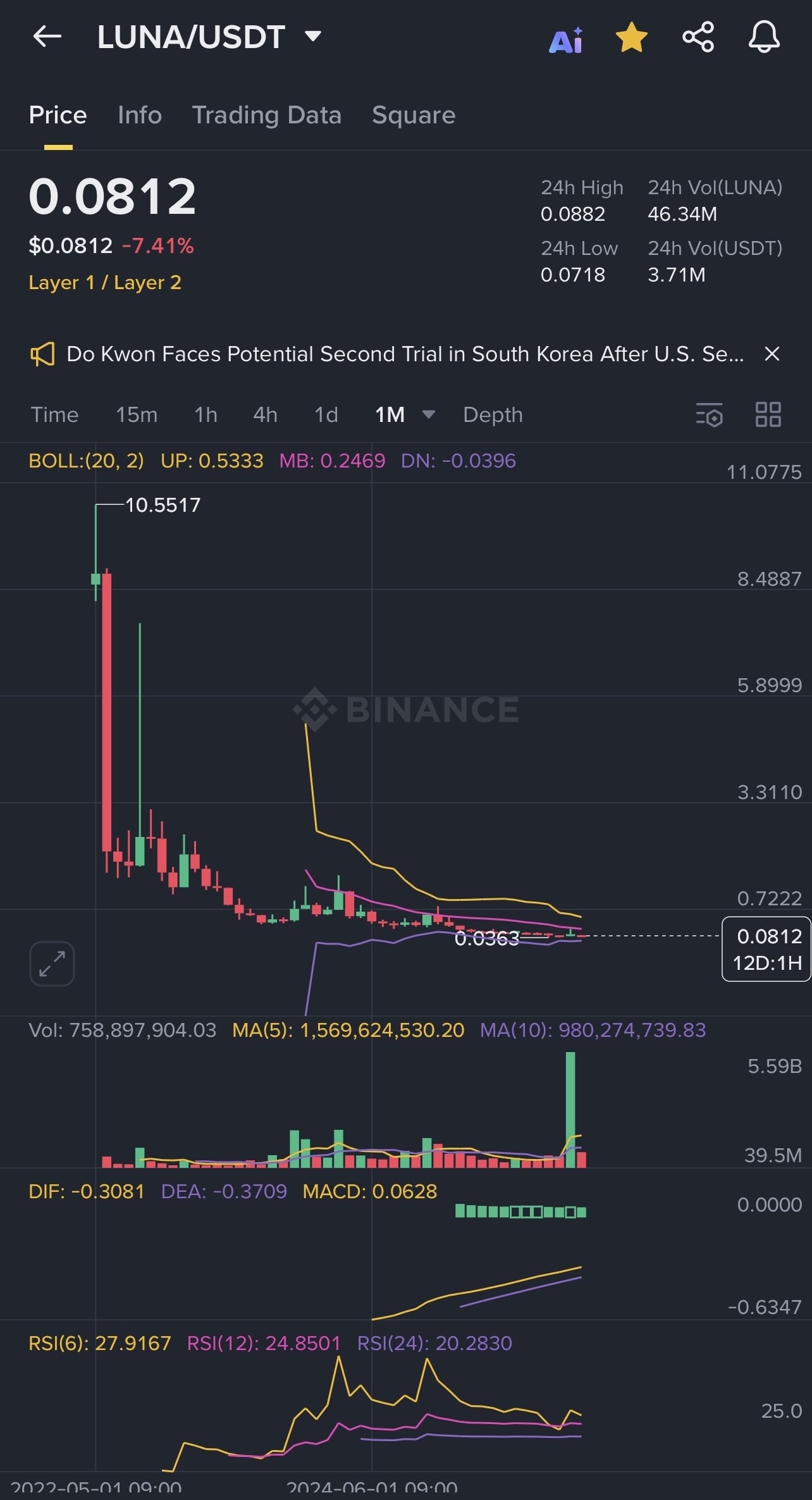
Price context

LUNA’s price has not shown a sustained recovery trend over multiple years.

This is not presented as evidence that inflation “causes” price decline, but simply as an observable outcome during a period of continued issuance and incentive-driven policies.

If inflation were meaningfully translating into long-term confidence or capital accumulation, we would expect at least some structural stabilization to emerge over time.

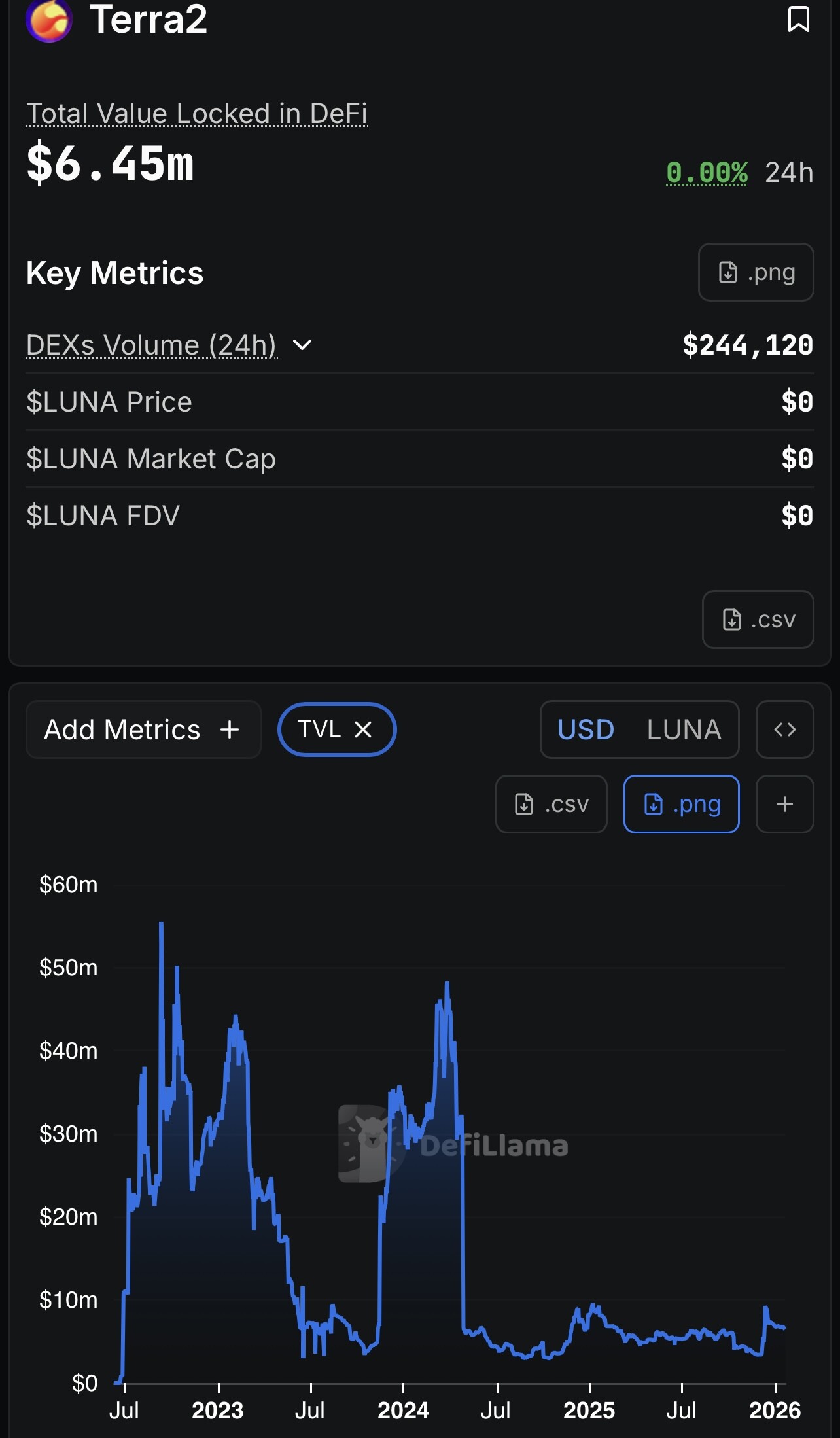
TVL context (USD)

Looking at DeFiLlama, Terra’s TVL has increased at specific points, but much of that growth coincided with community pool deployments.

That raises a legitimate question:

Should internally deployed capital be interpreted the same way as externally attracted capital?

Community pool deployments can increase reported TVL and signal ecosystem activity, but they do not necessarily reflect new market demand or external capital inflows.

If TVL growth is primarily funded by the ecosystem itself, it shows participation — but not necessarily capital confidence.

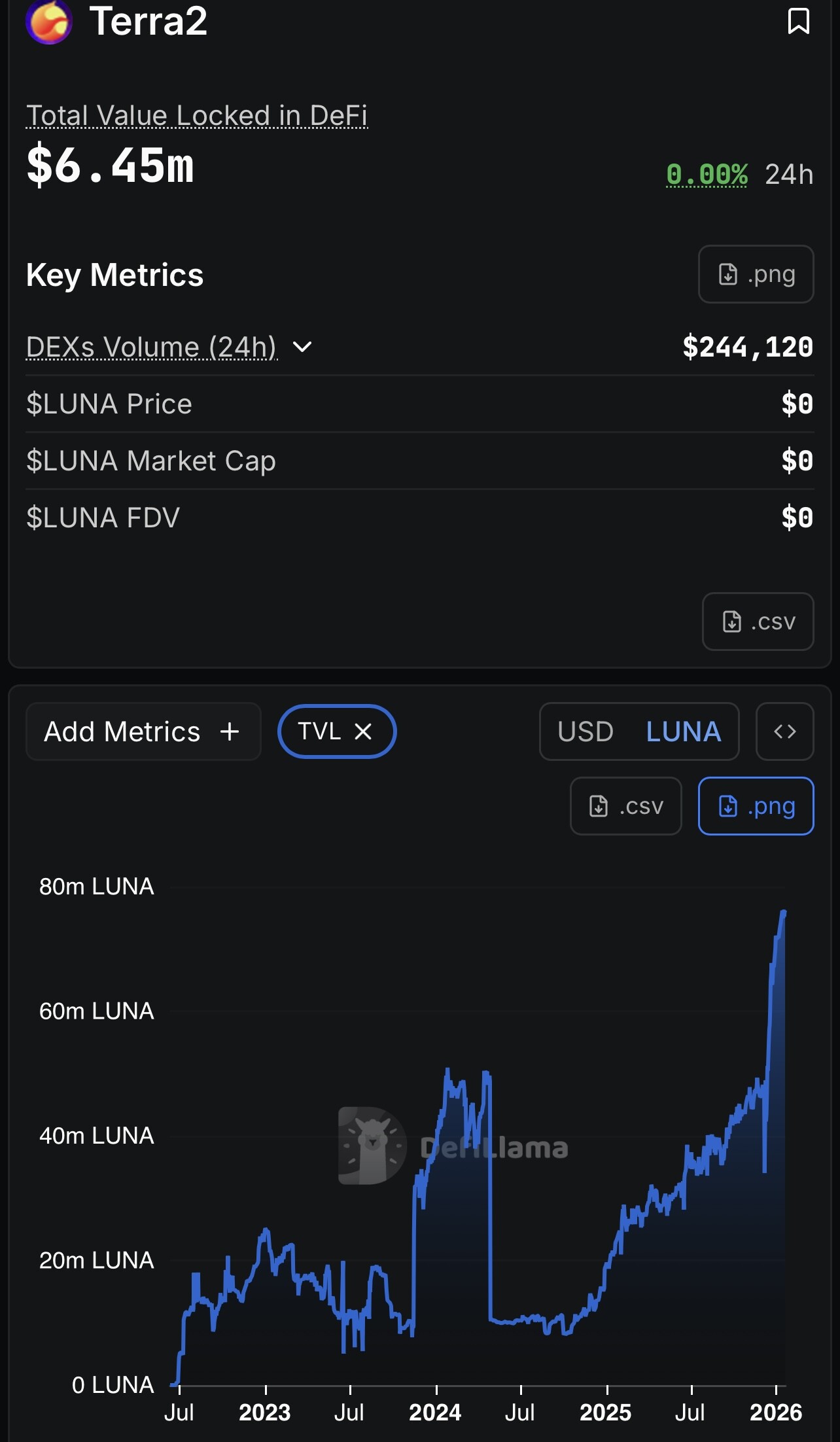
TVL context (LUNA-denominated)

When measured in LUNA terms, TVL has generally increased over time.

However, when measured in USD terms, TVL has remained flat or declined.

This highlights an important dynamic:

TVL is a function of token quantity × token price.

Emitting more tokens can increase LUNA-denominated TVL, but if token price trends downward, USD-denominated TVL — the metric most external capital looks at — does not meaningfully improve.

This makes it difficult to argue that higher inflation alone is strengthening fundamentals.

On Alliance and incentives

The same logic applies to Alliance.

Since its launch in December 2024, Alliance has expanded reward opportunities and participation surfaces.

However, it has not yet demonstrated durable net TVL growth driven by external users or capital.

More incentives can increase short-term engagement, but incentives alone do not guarantee sustained demand.

Framing the actual question

I fully agree that price appreciation cannot be “turned on” simply by cutting inflation.

But the inverse is also true: sustained inflation has not, so far, produced clear evidence of durable growth either.

This is why I’m not framing inflation reduction as a replacement for development, fees, or usability.

All of those are necessary.

The question I’m raising is narrower and more practical:

After several years of limited measurable results, should continued reliance on inflation as the primary growth lever remain the default assumption?

Or is it reasonable to begin discussing whether gradual, carefully managed adjustments could be part of a broader long-term strategy?

Closing

This is not a proposal to remove inflation or weaken security.

It is a call to examine whether current issuance levels are still the most effective tool for attracting long-term capital — using data, not ideology.

The charts above are not presented as proof, but as context for why this discussion is being raised.

That’s the conversation I believe Terra needs to have.

Thanks for the thoughtful and constructive feedback — I largely agree with the direction you’re suggesting.

My original intent was never to argue that inflation itself is “the problem,” nor to claim that lower inflation automatically leads to higher prices. I’m explicitly thinking in terms of a best-case framework: if the chain can afford it, then gradual reduction should be an option — not a default or a forced path.

I think reframing this proposal as conditional and reversible, with clear guardrails around chain health, makes it significantly stronger.

In particular, I agree with:

• Removing any perception of an automatic glidepath

• Making reductions explicitly conditional on bonded ratio, validator participation, staking APR, and overall chain health

• Treating vesting + mint inflation together when evaluating total supply growth

• Avoiding “store of value” framing and instead focusing on the long-term shift toward fees/usage funding security

• Assuming flat price and requiring data snapshots for every step

That aligns well with what I was trying to get at conceptually: this is not about cutting now, and not about optimizing for optics or short-term price reactions. It’s about defining when and under what conditions reducing long-run dilution could make sense — and being explicit that if those conditions aren’t met, nothing changes.

I’m happy to incorporate these suggestions and adjust the proposal accordingly.

If anything, this makes the discussion more honest and grounded: inflation remains a critical tool, but not one that should be treated as untouchable or unexamined forever.

Appreciate you taking the time to help refine this — this is exactly the kind of feedback I was hoping for.

You can reference the vesting schedule at the link below.

According to the published data, approximately 120,562.6 LUNA is unlocked daily until May 1, 2027.

All good. I think we need to move forward and evolve or die , like most of cosmos has already

1 Like

Draft message to Elster

Thanks again for the detailed feedback — it was very helpful.

I’d like to incorporate your suggestions, but in a targeted way rather than rewriting the proposal entirely. Below is how I’m thinking about adjusting it, section by section.

  1. Title (change)

Current:

“Gradual Inflation Reduction Proposal – Laying the Foundation for LUNA as a Long-Term Store of Value”

Proposed change:

“Conditional, Gradual Reduction of Mint Inflation (Subject to Chain Health)”

Rationale:

This removes any implication of a guaranteed path or store-of-value framing, and makes the conditional / reversible nature explicit at the title level.

  1. One-line summary (rewrite, 2–3 lines)

Current:

“This is not a proposal to eliminate inflation, but to manage it gradually within a range that preserves network security.”

Proposed change:

“This is not a proposal to eliminate inflation, nor a claim that lower inflation leads to higher price.

It proposes a conditional framework to reduce long-run dilution only if the chain can afford it.

If conditions are not met, no changes occur.”

Rationale:

Addresses misinterpretation up front and sets expectations clearly.

  1. Section 1 – Background (minor edits, last paragraph)

I plan to keep most of Section 1 intact, but modify the final paragraph to remove “store of value” implications.

Current (last paragraph intent):

“…may weaken a token’s role as a store of value.”

Proposed adjustment:

Replace with language along the lines of:

“…over time, reliance on issuance-driven rewards can limit the transition toward a model where security is increasingly supported by fees and real usage.”

Rationale:

Aligns with your suggestion to avoid SoV framing and focus on fee/usage-supported security.

  1. Section 3 – Supply Growth Structure (add clarification, 2–3 lines)

Add a short clarification at the end of Section 3:

  • Vesting and mint inflation should be considered together when evaluating total supply growth.

  • No reduction is implied during periods where vesting dominates supply expansion.

Rationale:

Makes clear this is not a “cut now” proposal and explicitly ties reductions to post-vesting or stronger usage conditions.

  1. Section 4 – Proposal Framework (key structural change)

4.1 Adjustment Process

I will modify this section to explicitly state:

  • No automatic reductions

  • Any adjustment requires guardrails to hold for a sustained period (e.g. 60–90 days)

4.2 Upper Bounds

I plan to:

  • Keep the upper bounds concept

  • Clarify that these are maximums, not a glidepath

  • State explicitly that reductions may be paused or reversed if guardrails break

Rationale:

This preserves the intent (slow, bounded change) while removing any sense of inevitability.

  1. New subsection under Section 4: Guardrails (brief)

Add a short list of preconditions, such as:

  • Bonded ratio stability

  • Validator participation / concentration stability

  • Staking APR above a defined floor or increasing fee share

  • General chain health signals

Rationale:

Ensures security and validator economics are always first-order constraints.

  1. Section 5 – Best-Case Supply Outlook (clarification)

Keep the section, but add one explicit sentence:

“These figures assume flat price and stable participation, and are provided purely as illustrative best-case references, not expectations.”

Rationale:

Avoids price assumptions and reinforces the non-prescriptive nature of the numbers.

Overall, my goal is not to change the spirit of the proposal, but to make it safer, more conditional, and harder to misinterpret.

I think your suggestions materially improve the proposal’s clarity and reduce governance risk.

Let me know if this direction matches what you had in mind — happy to iterate further.

1 Like

Looks good. I would propose also we answer the following questions to drive the debate further :slight_smile:

  • What guardrail thresholds (bonded ratio / APR floor / rollback window) make sense right now
  • Which 2–3 usage metrics should we count and material to the proposal
  • And finally should reductions wait until vesting/unlocks fall below a defined share of new supply or not?
1 Like

Inflation reduction has been nearly universally the signal of a dying chain’s final attempt to survive. Terra’s future is bright, and reducing inflation sends the wrong message. At 7% inflation is not excessive. Inflation funds TLA, which is what makes Terra unique and is arguably its best feature.

Terra needs more utility for Luna. I’d like to see a staking an/or locking requirement for TLA. Other protocols have recently implemented similar ideas, such as a multiplier for locked tockens that can earn the maximum rate.

For example, each unit of voting power allows a certain $ amount of TLA staking to earn the maximum rate. Anything over that amount would earn at a lower rate, or for accounts with no voting power, nothing at all. The rewards from non-voters are allocated to the voters.

This is a just an example, but I think we should focus on making reasons to buy and hold Luna instead of trying to give stakers less Luna to dump.

1 Like

I’d talked about a tiering model on tg chatter, with an option for instant unlock at 50% penalty with those funds going back into the system, a higher yield for a 6 month or 3 month unlock and some middle ground. Just because inflation is reduced doesnt mean that TLA rewards lessen, it means a redirection of inflation would be needed … which is a good thing dont you think ?

1 Like

my 2cents to the discussion, Inflation is high, and I agree we should aim/try to stabilise it somehow, however, not by eliminate it. Zero inflation would fundamentally change Terra’s economic model, including Alliance and validator incentives, and would require a much broader redesign of the chain’s security logic.

That said, inflation pressure can also be addressed from another angle, like the validator set size for example.

Terra currently runs with ~130 validators. That is unusually large for a chain at this stage and creates several inefficiencies:

  • Higher operational overhead across the network

  • More missed rounds and coordination latency

  • Larger state and block propagation overhead

  • Higher aggregate infrastructure cost for validators

A smaller active set would materially improve performance and reduce security costs per unit of stake.

A gradual reduction could be explored, for example:

  • Phase 1: 130 → 80 validators

  • Phase 2: 80 → 50 validators over ~6 months

This would:

  • Improve block production reliability

  • Reduce consensus overhead

  • Lower validator operating costs

  • Increase per-validator rewards without increasing inflation

In other words, it improves security efficiency rather than just changing issuance parameters.

Inflation reduction and validator set right-sizing are not mutually exclusive but if we want to improve Terra’s economics sustainably, we should be looking at structural efficiency gains, not only monetary policy.

4 Likes

I’ve incorporated your point as a prerequisite discussion rather than a direct change.

In the updated draft, I added a section (4.4) acknowledging that validator set size and “dead stake” are structural factors that may need to be addressed before or in parallel with any long-term inflation adjustments.

To be clear, this proposal does not suggest changing the validator set itself.

It simply recognizes that many contributors see validator set optimization as a potential first step, and that any such change should be handled through a separate proposal and governance process, before re-evaluating inflation.

Appreciate you raising this — I agree it’s an important part of the broader sequence.

We just had “the conversation” and it seems you will only accept “YES”.

For me it is a clear “NO”, I explained the reasons above.

1 Like

think there needs to be a deflationary and optimisation “roadmap” perhaps in one proposal ? The idea of consildating validators has alot of merit but its a political hot potato for sure :slight_smile: but I like it :::::slight_smile: I think it better fits in a single vision for optimisation of the chain ?

1 Like