Phoenix Foundation: Appointment of an Emergency Supervisor

Why I am submitting this proposal

In June 2024, when Terraform Labs announced it was winding down, a small group of us asked the Terra community to trust that Terra could continue without a Labs company. The Phoenix Foundation was created to help secure the chain, support builders and keep the ecosystem moving forward. I still believe strongly in that mission.

As part of my role within the Foundation, I am responsible for strategic leadership and organizational oversight. That includes helping ensure that the Foundation remains capable of carrying out its mandate and that its Directors remain accountable for the responsibilities entrusted to them. Where serious questions of governance or accountability can no longer be resolved internally, I consider it part of that responsibility to escalate the matter to Terra Governance.

The issue

The Phoenix Foundation currently has four Stewardship Directors. Proposal A272, concerning the continued membership of one Director, has resulted in a 2–2 deadlock. The serious concerns behind that proposal relate to strategic alignment, governance procedures, contribution and accountability, risk management and Director-level trust.

Those concerns are disputed, and this proposal does not ask Terra Governance to decide who is right.

The immediate problem is that the Stewardship is evenly divided on a question concerning its own composition as a result of these serious concerns and cannot resolve it internally. A governing body also needs a credible mechanism to hold its members accountable when serious concerns arise. Without one, accountability effectively ends wherever an internal deadlock begins.

Proposed solution

The Phoenix Foundation Bylaws provide for the appointment of an independent Emergency Supervisor in circumstances where the Foundation’s governing bodies become unable to properly perform their responsibilities. I believe this is the appropriate mechanism here.

The Supervisor should review the circumstances and issues leading to A272, hear from all four Directors, examine the relevant internal records and independently determine how the situation should be resolved. This may include concluding that a change to the Stewardship is necessary, or that it is not. Both outcomes must remain possible.

The appointment should be strictly temporary and limited to this specific matter, with a maximum term of four weeks from acceptance of the appointment unless Terra Governance explicitly approves an extension.

I am directly involved in the current dispute and supported A272. For that reason, I am not asking Terra Governance to accept my assessment of the matter. I am asking for an independent process capable of reaching a conclusion where the Stewardship itself cannot, and I will accept the outcome of that process even if I disagree with it.

Selecting the Emergency Supervisor

The Emergency Supervisor should be chosen by the Terra community rather than by either side of the dispute. Candidates should be discussed openly before the final governance proposal is submitted.

Any candidate should meet the following conditions:

  • no current or past financial relationship with the Phoenix Foundation, any Director, or any team affiliated with a Director;

  • no pending or prior application for Foundation funding;

  • no current or recent role in Terra governance, the Stewardship or the Veto-Multisig;

  • no public position taken on A272 or the underlying dispute;

  • no personal or professional relationship with any of the four Directors that could reasonably be seen as compromising impartiality;

  • ideally, prior experience using Terra and familiarity with the ecosystem.

Two potential candidates raised:

  • Ray Raspberry — long-term Terra community member, on-chain researcher and investigator.

  • Martin — long-term Terra community member, Canadian lawyer and significant DeFi liquidity provider.

Both have been acknowledged as potential candidates by three of the four current Stewardship Directors. This should not be understood as a predetermined appointment or endorsement. The candidates are presented for community discussion, and additional candidates may be proposed.

Proposed Governance Action

By Emergency System Governance Process, Terra Governance is asked to:

  1. Recognize the serious Stewardship dysfunction underlying Proposal A272, and the resulting inability to resolve these issues internally (2-2), as an Adverse Event under the Phoenix Foundation Bylaws.

  2. Appoint the Emergency Supervisor selected following community discussion under Article 2.6.1.

  3. Instruct the Emergency Supervisor under Article 2.6.3 to investigate the Adverse Event, hear from all four Directors, review the relevant records, the conduct of any Director where relevant and determine how it should be resolved.

  4. Confirm that the Emergency Supervisor may exercise the powers available under Article 2.4.5.4, including instructing the removal of a Stewardship Multisig Member where the Supervisor determines that this is necessary or desirable to resolve the Adverse Event.

  5. Limit the appointment to a maximum of four weeks from the Supervisor’s written acceptance, unless Terra Governance explicitly approves an extension. The written acceptance will need to include a statement of independence.

  6. Set compensation for the Emergency Supervisor under Article 2.6.6 at an amount of up to USD 10,000, to be determined in the final governance proposal and paid from Foundation funds.

Appendices

The Stewardship has reached a question it cannot resolve internally. Rather than asking Terra Governance to take sides, I believe the fairest approach is to let the community appoint an independent person, give that person access to the full facts and allow them to reach a decision.

1 Like

Another potential candidate for the position of emergency supervisor would be Grace Yuh from CLK. We’ve seen that she is pretty thorough in her investigations and I believe she’d be very qualified in this instance.

(Don’t know if she matches the other criteria regarding the absence of relationship with any of the directors)

Thanks Philipp for putting this to the community. I agree that Terra governance should have the final say, and I welcome an independent review. The independence criteria in your post are good, and I’d support them for any appointment. A few facts are missing, though, and they matter for how the community might vote.

1. A272 was more than a removal. It had two messages: removing me from the member group, and changing the PF DAO threshold to 60%. After the removal that means 2 of 3, so two directors could pass anything on their own. Community can check it here: Phoenix DAOs

2. One failed vote is not a “persistent deadlock”. Since A272, the board has passed 10 of 11 proposals (A273 to A283): payments, including monthly salaries for the other 3 directors (there has not yet been one for me deliberately by Phillip), liquidity moves and asset-staking updates, most of them proposed by Philipp and approved with/including my vote. The Foundation is functional. A proposal that didn’t reach the threshold simply failed. That is how a 3-of-4 board is meant to work.

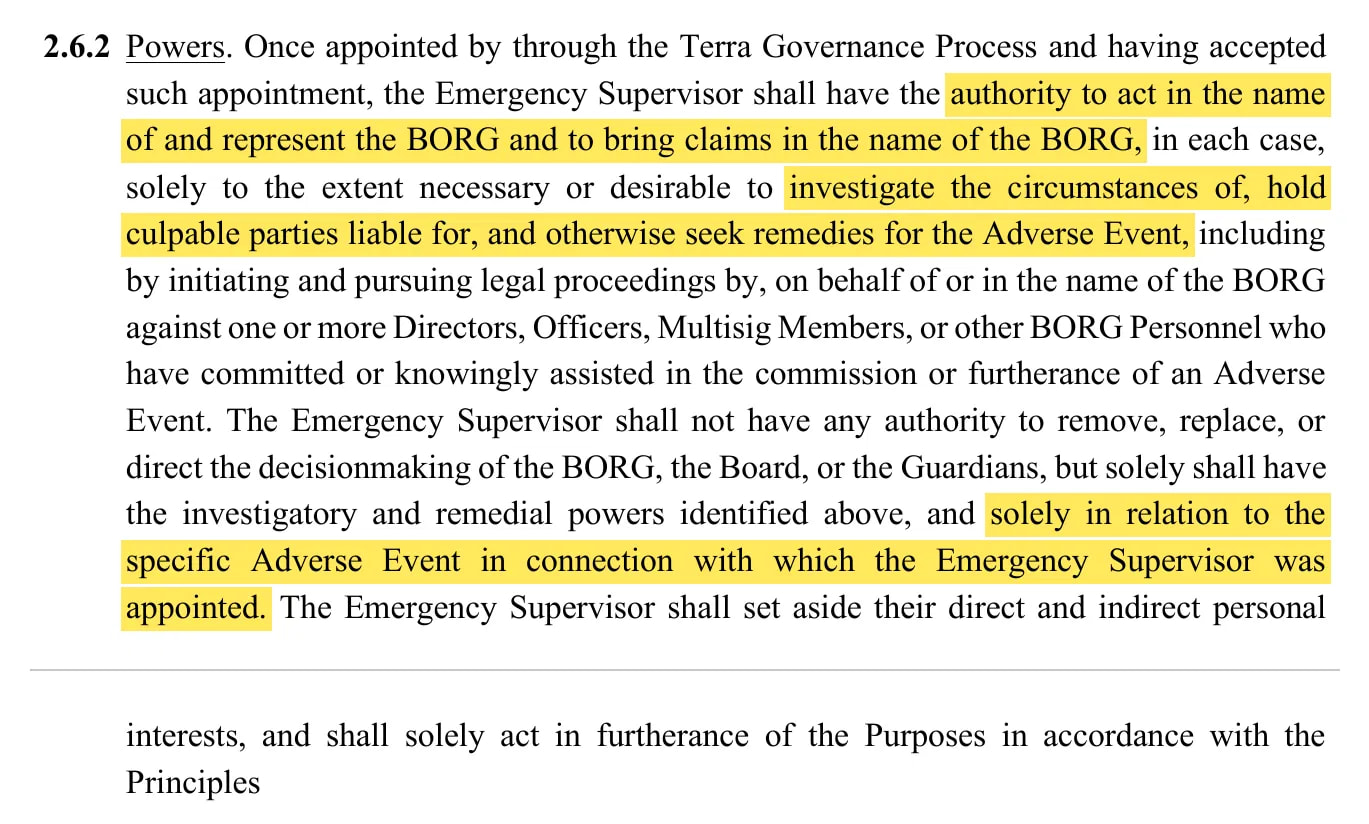
3. Item 4 asks community to interpret conflicting bylaws. Art. 2.6.2 says the Emergency Supervisor “shall not have any authority to remove, replace, or direct the decision-making of the BORG, the Board”. Art. 2.4.5.4 says directors should facilitate a removal if a Supervisor instructs one. These two contradict each other. An emergency governance vote is not the right place to settle that, and certainly not by granting the removal power in advance.

4. The bylaws already provide a standing referee that PF has never appointed. Art. 2.5.1: “The BORG shall at all times have a supervisor… able and willing to supervise the management of the BORG.” The Emergency Supervisor in Art. 2.6.1 is described as an “additional” Supervisor. Before declaring an emergency, the board should appoint the permanent Supervisor the bylaws require. One of the candidates in this thread could fill that role, with the same independence criteria.

On candidates, two suggestions in the spirit of Philipp’s criteria. First, every candidate should publicly disclose any personal or professional relationship with any of the four directors before a vote. Second, the Emergency Supervisor’s powers in Art. 2.6.2 are mainly legal (investigating, holding parties liable, bringing claims under bylaws), so legal or governance expertise should come first than Terra familiarity. Art. 2.6.1 allows “one or more” Supervisors, so a pair (one legal/governance expert, one experienced Terra community member, both independent) would balance the two.

To Conclude: The community should be aware of context and what they are voting. If the community wants to decide who sits on the board, I’d accept a direct, transparent Terra governance vote on that question, rather than an emergency process built around one disputed vote.

I remain committed to address any questions the community might have to this or any matter related to Terra.

Thank you, Vini

2 Likes

Grace Yuh does not meet the independence criteria.

  • She is part of the leadership of another chain,
  • I have prior AADAO-related history with her,
  • and PF has ongoing strategic discussions related to Cosmos Labs.

A272 was clear: a removal necessarily will always come with a move to 2-of-3 so one remaining Director could not unilaterally veto the Foundation, bylaws and the foundation board explicitly states that the majority decides. Routine payments passing afterwards do not erase a 2-2 deadlock on a fundamental Stewardship issue. The Bylaws are also not contradictory: the Emergency Supervisor cannot directly remove a Director, but can instruct Stewardship to facilitate removal. And the missing standing Supervisor is a separate governance issue, not a reason the Emergency Supervisor process suddenly cannot be used.

This is again a diversion into procedure instead of addressing why the proposal exists.

Community members and validators should read the actual substance and consider the risks Terra has been exposed to. While I have repeatedly been the one identifying problems, escalating them and putting out fires, serious security risks have been downplayed to the point where Terra came dangerously close to catastrophic liquidity loss.

That is what this is about: mandate, contribution, governance, security judgment, trust and accountability. Not procedural word games.

I will not accept potential legal exposure arising from potentially negligent conduct by another Director. When someone downplays existential security risks while questioning whether Terra should even remain focused on DeFi, I genuinely have to wonder whether you even hold meaningful assets on Terra yourself.

And this is exactly why Terra Governance is being asked to appoint an independent Emergency Supervisor: not to accept my version of events, but to review the internal discussions, speak with all four Directors, assess the facts independently and determine how the Adverse Event should be resolved. The proposal explicitly leaves both outcomes open.

Having considered the discussion and the relevant provisions of the bylaws, I believe the community should reconsider whether appointing a single Emergency Supervisor is the most appropriate approach, given the seriousness of the situation and the potential consequences of this appointment.

Article 2.6.1 expressly allows for the appointment of one or more Emergency Supervisors. I therefore believe the proposal should be amended to provide for at least three genuinely independent Emergency Supervisors, rather than placing such significant responsibility and influence in the hands of one individual.

This is an important decision for the Foundation and the wider community. Regardless of anyone’s personal reputation or existing relationships, placing so much responsibility in the hands of a single person creates a concentration of influence that could be avoided. A small group of independent individuals would offer a better opportunity for balanced judgement, different perspectives and appropriate scrutiny.

I would also ask that an open application process be established.

Rather than selecting a specific individual or presenting the community with a predetermined choice of candidates, anyone from the community who meets clearly defined eligibility criteria should have the opportunity to apply. Each candidate should publish their relevant experience, proposed approach and compensation requirements, together with any professional, financial or other relevant relationships that could reasonably be perceived as affecting their independence.

The community should have the opportunity to review these applications, ask questions and assess the candidates before voting. The selection process should be transparent, with the same requirements and standards applied to everyone.

A person may be well regarded, experienced and trusted by many community members, and those qualities should certainly be considered. However, reputation alone cannot replace transparency. We may know that someone is a good person or has made valuable contributions, but that does not necessarily mean we know the full extent of their relationships, affiliations or potential conflicts of interest. These matters should be disclosed and assessed openly rather than left to assumptions.

The mandate of the appointed Supervisors should also be clearly defined, including their powers, compensation, reporting obligations, decision-making arrangements and the process for resolving disagreements. The community should understand how the Supervisors will operate collectively and how their independence will be maintained throughout the appointment.

The investigation itself should establish whether the circumstances satisfy the bylaws’ definition of an Adverse Event, examine the evidence regarding the alleged persistent deadlock, and assess any substantiated concerns about governance, accountability and risk management. All parties should have a fair opportunity to present their positions, and any findings should be evidence-based.

It is equally important to clarify the limits of the Emergency Supervisors’ authority. Article 2.6.2 restricts their ability to remove or replace Directors or direct Board decision-making, while Article 2.4.5.4 addresses the facilitation of removals following an instruction from an Emergency Supervisor. The relationship between these provisions should be explained clearly so that the community understands the powers it is being asked to authorise.

I also believe we should consider what happens after the current emergency has been resolved.

Article 2.6.1 makes clear that Emergency Supervisors are not intended to remain indefinitely. Their appointment should therefore have a clearly defined scope, duration and conclusion, with transparent criteria for determining when the specific Adverse Event has been addressed.

At the same time, resolving the immediate dispute should not prevent the Foundation from improving its longer-term governance and oversight. The investigation could help identify gaps in expertise, accountability or representation that would benefit from being addressed separately.

Where additional expertise or perspectives are needed, the Foundation should consider appropriate ways to bring them in through transparent processes. This could include people with complementary experience in technical security ,markting ,reach, wider ecosystem and community relations. Any permanent supervisory appointment or other ongoing role should be handled separately under the relevant provisions of the bylaws, rather than automatically extending an emergency appointment beyond its intended purpose.

The objective should not be to favour or target any particular Director. It should be to establish the facts, protect the ecosystem, and ensure that any necessary remedies follow a fair, transparent and properly authorised process.

My request is therefore that the current proposal be amended to provide for at least three Emergency Supervisors and that an open, public application process be established before candidates are selected. The community should have a genuine opportunity to evaluate the available candidates rather than being asked to place its confidence in one individual chosen in advance.

This is a significant decision with potentially far-reaching consequences. The selection process must be as robust, transparent and independent as the responsibilities these individuals will be expected to undertake. We should use this opportunity not only to address the immediate situation but also to consider how the Foundation can develop stronger, more decentralised oversight in the future.

1 Like

We would prefer personal responses rather than walls of AI-generated text, but your points are pretty simple.

  1. Three Emergency Supervisors would be okay, as long as they meet the requirements and there is broad agreement within PF (and the community). We already reached that for the two names mentioned.

    However in this case a single supervisor would be a more efficient way of resolving this in a timely way so that we can get back to business. Hence the current prop asks the community to select one of 2 candidates.

  2. An open application process can be done through this forum thread. Anyone who wants to be considered can put themselves forward, show that they meet the stated requirements, disclose any relevant relationships, and explain why they are suitable. The community can then comment openly before the final candidates are selected. I’ll also coordinate with PF so our view on whether someone meets the criteria is given here transparently. If no suitable third person can be found, the proposal will still go ahead with only 1, so it should not block the process. Target for on-chain publishing is end of next week.

  3. PF structural changes should not be mixed into this process. The current issue needs to be resolved first.

Yes, this process can have a major impact on the ecosystem. That is exactly why it is necessary. PF needs to get back into a position where it can actually act, especially with more security incidents, infrastructure problems and fires to put out.

We need a Foundation that is pulling in the same direction and focused on protecting and growing Terra, not one consumed by internal political fights, downplaying security issues, lethargy and non-contribution or slowly turning Terra into Terra Classic through stagnation, risk aversion and an inability to act.

As you know, English is not my first language, so yes, I use AI to help correct my grammar and express my thoughts more clearly. But I don’t think that should be the point of discussion; what matters is the substance of the arguments.

I appreciate that you agree the Foundation needs improvement and that having three Emergency Supervisors is a reasonable approach. I also agree that the current situation needs to be addressed without unnecessary delays.

Regarding the selection of candidates, I believe this should ultimately be decided through community governance. The application process should be open, transparent and give the community a genuine opportunity to assess the candidates, rather than leaving the decision mainly to the Foundation itself.

On the question of improving the Foundation’s structure, my point was not to delay accountability. Quite the opposite. I believe we could use this opportunity to address the immediate problem while also laying the groundwork for a stronger and more decentralised structure in the future.

If we are already appointing independent people to help resolve the current situation, why not take the opportunity to consider how we can bring more experience, different perspectives and new contributors into the Foundation? This could help us address not only the immediate dispute but also some of the structural weaknesses that may have contributed to it.

Of course, the emergency process should have a clear mandate and should not be held up by broader reforms. But resolving the current issue and improving the Foundation do not have to be mutually exclusive.

My concern remains that we should not place so much responsibility in the hands of one person, or predetermine the outcome before the process has run its course. We should give the community a meaningful role in selecting the people involved and ensure that the process is fair, transparent and independent.

Ultimately, we all want a stronger Foundation that can protect and develop Terra. I believe we have an opportunity here not only to resolve the current situation, but also to take a positive step towards making the Foundation more accountable, decentralised and representative of the community.

1 Like

Thank you for the input. The current proposal follows the existing Bylaws and the process they provide for appointing an independent Emergency Supervisor. The immediate issue needs to be resolved first under the existing structure and governance framework.

Suggestions regarding broader governance reform, additional oversight mechanisms or changes to the Foundation’s structure are noted and can be considered separately once the current process has concluded.

For now, the focus should remain on resolving the matter before us through the process already defined.

1 Like

I agree this needs to be resolved as soon as possible. My suggestion is to open the process to the whole community, allowing anyone who meets the requirements to put themselves forward. Rather than proceeding with one Emergency Supervisor, I believe we should consider three independent supervisors, with the community assessing the candidates and deciding through governance who should serve.

1 Like

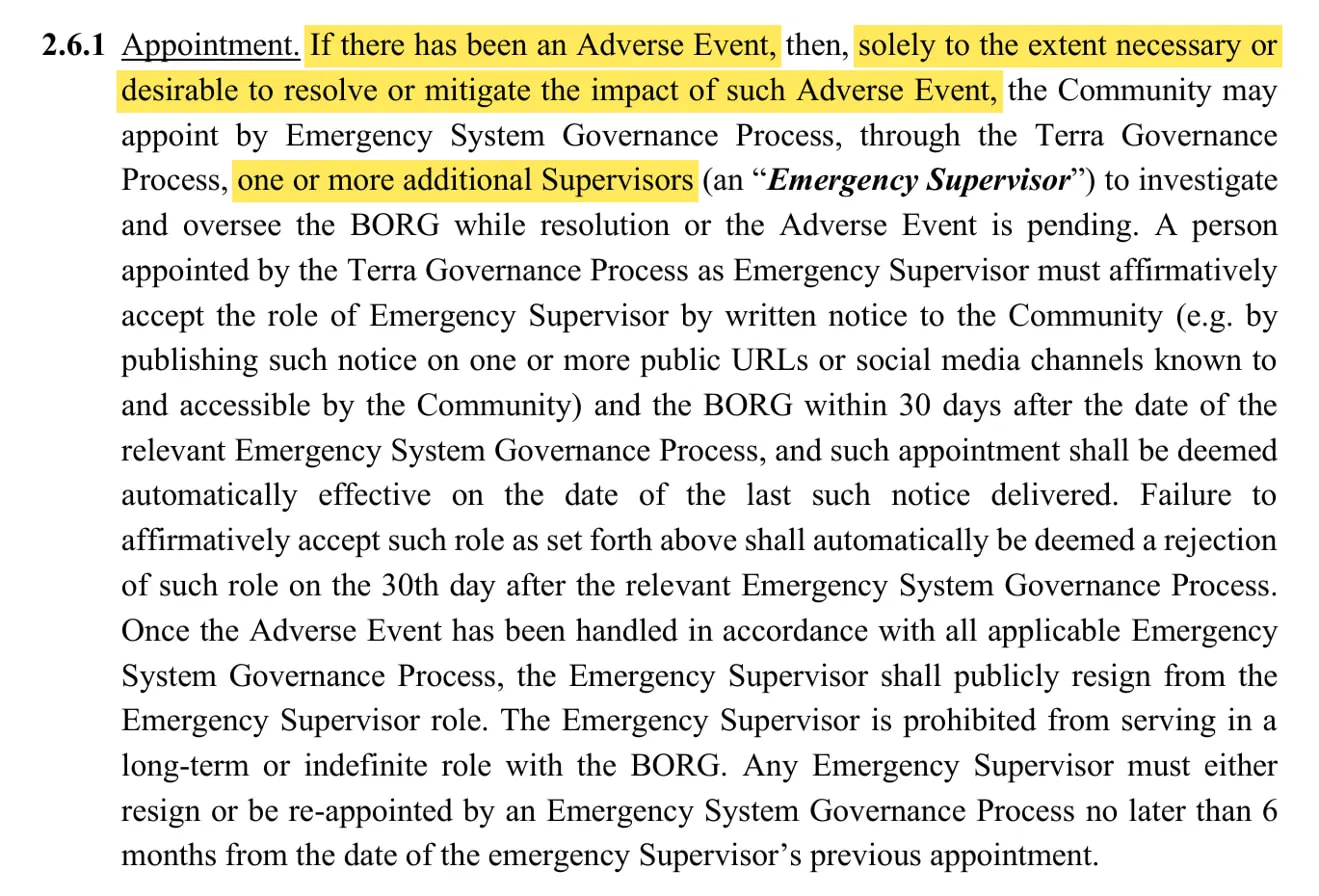
The proposal rests on item 1. Article 2.6.1 only allows an Emergency Supervisor “If there has been an Adverse Event”, and item 1 asks Terra governance to recognize “the persistent 2–2 Stewardship deadlock” as one. The record doesn’t show that.

* A272 got 2 yes votes out of 4 (Philipp and MB yes, Rose no, Vini didn’t vote), short of the 75% every proposal needs. Article 3.1.3.2(c) requires that threshold for any Board action through the multisig, so “the majority decides” doesn’t apply, and 2 of 4 isn’t a majority anyway.

* Since A272 opened, all 11 proposals have reached the threshold, including steward pay and liquidity moves. Vini voted yes on 9 of them.

* No proposal in 283 has ever split 2-2. Failures are normal under a 3-of-4 threshold: 14 of the 271 proposals before A272 failed.

Item 1 relies on the part of the definition covering anything materially adverse to the Foundation’s ability to perform its duties, “including without limitation any persistent deadlock or dysfunction of any Body”. One failed removal vote, while everything else passes, is the threshold doing its job. If the proposal rests on something else, such as the negligence post 5 alludes to, it should say so and set out the evidence. If the real question is who sits on the Board, Terra governance can be asked that directly, as Vini suggested.

1 Like

Have you read proposal A272?

Risk Management / Trust: Serious failures in the handling of material ecosystem risks. Written security concerns about Astroport’s dependency on Neutron governance were dismissed days before that risk materialized, potentially exposing about $4.4M of Terra liquidity. Material information concerning Astroport was also held through private communications without being equally shared with other Directors while a fork or takeover was being discussed. The combination of risk judgment, information handling and stepping away during the incident has resulted in a material breakdown of Director-level trust.

Normally, you seem pretty interested in chain security (or lack thereof).

Thank you for the input. The proposal A272 shows a clear internal dysfunction, that will not be resolved internally, updated the proposal text to make that more clear.

We are following the Bylaws to appoint an independent Emergency Supervisor. Other PF members have already engaged with this process and agreed with the options being put forward, acknowledging the need for an independent review and resolution.

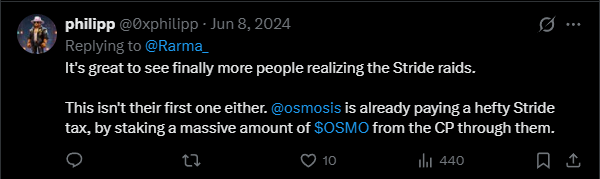
Separately, I think, your Neutron governance attack report omitted that MB and I were the ones who identified and reported the issue and triggered the process for an immediate Neutron chain halt, while roughly $4.4M of Terra liquidity was exposed.

1 Like

Thanks to Vegas and Vini for the substance so far. I’ll keep this to what I think the appointing proposal needs to say before it goes on chain, so that whoever is appointed has the community’s confidence regardless of what they conclude.

1. Three supervisors, open applications, written conflict disclosure. Philipp has said three would be acceptable and that applications can come through this thread. I’d ask that the on-chain text commit to that rather than default to one, and that every candidate including the two already named, post a written disclosure covering. Any current or past grant, delegation, salary or contract from the Foundation or from a company a Director runs any TLA, Votion or Eris position of material size and any personal relationship with a Director. Not to disqualify anyone, but so the community can judge independence itself rather than take it on assurance.

2. Terra pays them, not the Foundation. The proposal offers up to $10,000 from Foundation funds. The Bylaws (2.6.6) allow compensation to be set by the Emergency process subject to Community approval, so I’d ask that it be paid from the community pool through the same governance vote, fixed in advance, and not conditional on the outcome. The people being reviewed should not be the people signing the reviewers pay.

3. A mandate that includes both sides and the structure, with a published report. The supervisors should hear each Director, review whatever any of them submits, and publish a written report to the community before any action is taken. The mandate should include the question the Bylaws already raise: 2.5.1 requires a standing Supervisor “at all times,” and none has ever been appointed. That one applies to all four Directors equally and is exactly what an independent reviewer should be asked about.

4. The appointing vote should not pre-authorise a removal. Supervisors investigate and recommend the community decides on the recommendation. Folding the remedy into the appointment turns a review into a mechanism chosen by one side, whichever side it is.

5. If the outcome is a removal, the replacement comes with it. A272 would have taken the board from four at 75% to three at 60%, which is two people. Any removal should be packaged with a replacement of equivalent technical competence so the Foundation never operates as a 2-of-3. I’d also ask the supervisors to consider whether one or two seats should be community elected or unpaid and term limited, so that at least some votes on the board are held by people whose income does not depend on the Foundation’s own decisions. That’s not a comment on anyone currently serving it’s a design question about where independent judgment comes from.

None of this slows the process down. All of it can be in the text that goes on chain next week.

There’s a lot of text here, so let me quickly summarise my understanding to bring everyone up to speed:

— Despite otherwise being in agreement on literally every other proposal, Vini voted “no” on a single proposal that would have directly benefited 0xPhilipp.

— Claiming a “deadlock”, 0xPhilipp then tried to have Vini removed and move to 2-of-3 Rule

— The vote to remove Vini failed, but 0xPhilipp still withheld Vini’s pay last month anyway.

— 0xPhilipp is now proposing the community pay $10,000 for someone to agree with him.

— There is now a debate on who the patsy should be.

… Did I miss anything or does that about sum it up?

I guess you’re trolling.

I don’t control PF, and any PF member can put forward proposals. I also cannot “withhold” anyone’s funds if the Board decides they should be paid.

The claims that I am bribing someone to agree with me, or acting corruptly, are blatant allegations and I strongly reject them. I don’t take accusations like that lightly, Adam.

Most of Vini and Vegas messages is redesigning the process which already is defined in our bylaws, rather than discussing the underlying issues.

  1. Three supervisors and disclosures are fine if suitable candidates are available.
  2. Payment source is largely irrelevant. The Bylaws allow compensation through either the PF or Terra Governance. Just easier to execute & manage.
  3. The mandate should stay limited to the Adverse Event. A fully public report may not be possible where confidential material is involved, especially considering this including private discussions, which are confidential based on the Bylaws.
  4. Removal is not pre-decided. The Bylaws already define what an Emergency Supervisor can do if they conclude removal is necessary.
  5. A replacement is not required as part of the same process. We have approached candidates, but unsurprisingly they do not want to join during an active internal conflict.

Resolve the current issue first. Structural reform comes afterwards.

Appreciate the direct answers. Taking them in order.

Payment. If the source is “largely irrelevant,” then there’s no cost to paying from the community pool through the appointing vote and a real benefit. Nobody can later say the reviewers were paid by the reviewed. Convenience shouldn’t be the reason to leave that open.

Report. Agreed that confidential material can’t all be public. The standard elsewhere is a public findings and recommendation summary with a confidential annex available to validators under an NDA. The community is being asked to vote on whatever comes out of this it should be able to read what it’s voting on.

Scope. “Limited to the Adverse Event” is fine, provided the mandate includes the question of whether one exists that’s the point Rarma raised and it hasn’t been answered. Determining the threshold is the first thing an independent reviewer should do, not something the appointing text assumes.

Replacement. If candidates won’t join during an active conflict, that’s the strongest argument for tying the two together, not separating them. Otherwise the Foundation runs as 2-of-3 at 60% for an open ended period. A simple fix, if the supervisors recommend removal, it takes effect on the appointment of a replacement, or the threshold stays at unanimity of the remaining three until then. That’s not structural reform it’s the terms of this one process.

“Already defined in the Bylaws.” The Bylaws say the supervisors are appointed “through the Terra Governance Process.” Setting the terms of that appointment is governance doing its job, not redesigning the process. Also the one standing requirement the Bylaws do impose a Supervisor “at all times” under 2.5.1 has never been met, which is reason enough for the community to be careful about the terms this time.

Phoenix Foundation is a separate legal entity governed by Bylaws drafted with MetaLeX to cover precisely these kinds of situations. Terra Governance has specific powers over funding, veto and emergency processes, but neither the chain nor an individual forum user can simply rewrite that legal framework ad hoc.

The process defined in the Bylaws needs to be followed by the Directors. This proposal is therefore an informational notice asking Terra Governance to appoint an independent Emergency Supervisor, so that the defined due process is being followed. Nothing more, nothing less.

2 Likes

I’ve read this proposal, reread the A272 prop, read the discussion to date and, importantly, the bylaws of the PF BORG for the first time.

I’m viewing this prop and the broader discussion as focussing on establishing proper procedure to manage the current internal PF dispute.

When A272 first came to attention, I publicly voiced that I had concerns about some of the allegations, specifically those relating to the Neutron/Astroport security breach and the reference to potentially converting Terra from being a defi chain to a meme coin.

Without making any judgement, both those sets of allegations seemed existential to me and still do. So at that time I was of the view that it might be beneficial if the prop stalemated (which it has) and instead went to Terra for governance. I thought this would give opportunity for the chain to consider the context of the allegations and also for the director concerned to speak to them.

Having now read the bylaws in full, I am of a bit different mind as influenced by the following clauses and developments:

  1. Whilst we can see that PF has not yet had a persistent general functional impasse at a voting level, the circumstances of A272 can be seen as constituting an Adverse Event under the definitions. I am considering 2 respects:
    a/ wherein the charges constitute allegations of gross negligence notwithstanding potential harm to Terra was preemptively mitigated and,
    b/ the extent of the dispute is such that, despite having only one obvious voting impasse, the conditions now exist for persistent dysfunction of the BORG because there is unwillingness for all the directors to continue to work together without resolution of the dispute.

  2. Section 5 Confidential information provides clear direction on confidentialilty and PII. Essentially I read it that the contextual information around the allegations in the prop cannot be shared in a public forum because they are deemed by the board as confidential. In hindsight, this is the proper approach as board discussions and debate cannot generically be subject to public scrutiny, only the decisions and actions taken thereof. Terra Governance is thus the wrong place for a decision on the matter and I have to change my view to align with the bylaws/constitution of the BORG.

  3. While this is structurally an internal dispute for the BORG to resolve, it cannot be done by the current personnel structure because it’s a stalemated 4 person voting group, being defined as the members of the Multisig, with no tie breaking vote in place (aside: absence of a tiebreaker must be addressed too in my opinion). As this is stalemated and unchanging, a mechanism from the bylaws needs to be activated. For an adverse event, the appointment of an Emergency Supervisor/s is the localised solution (Section 2.6). The Emergency Supervisor is a temporary role and cannot be a long term or permanent role.

I note that the bylaws do require that a Supervisor (not emergency) should also have been in place from the beginning and, depending on the laws of jurisdiction governing the BORG, they may have had some powers to help resolve this dispute although such powers aren’t clear in the bylaws. (Section 2.5). However the BORG has failed in it’s obligation to make that appointment which could arguably also be seen as a general adverse event that should also be considered by an appointed Emergency Supervisor given the current stalemated board.

Practically, the board appoints a Supervisor, Terra Governance appoints an Emergency Supervisor/s

  1. There is an apparent willingness by all of the directors to abide by the direction of an emergency Supervisor/s. I used the term direction in the sense of advice as the bylaws constrain the Emergency Supervisors capacity to direct.

  2. This prop fulfills the requirements of the bylaws for the purpose of Terra Governance electing an Emergency Supervisor/s.

Two excellent candidates have been put forward, acceptable to the board. Personally I would support either or both if that’s what the chain decides.

My personal opinion is that it is unnecessary to have more than one Emergency Supervisor to resolve this situation. Further, to engender a whole discussion to expand the options also seems unnecessary and likely to be a significant time sync with potential for engendering disharmony. But if the weight of opinion goes that way then the Board should be open to revising the prop accordingly.

If it was to be one appointed, then my personal election would be for the party with the greatest legal experience to help secure the credibility of the BORG and it’s processes and steer it to correctly remedy the current weaknesses. These aren’t really addressed in this prop but I think it would be a good idea to revise the prop to empower the Emergency Supervisor to also review PF for compliance with the bylaws and recommend appropriate remedial action. Of the two candidates, Martin is the one with the most relevant legal qualifications.

  1. Apart from resolving the A272 dispute the 2 structural things I would like to see modified are those I referenced above:
    a. moving to an odd number of directors to ensure the presence of a tie breaking vote. This should be 5 or 7 max. Ideally all decisions could be resolved by consensus however strategically this may not always be possible and the board should be able to make decisions for action.
    b. The appointment of an ongoing Supervisor as that is required under the bylaws.
    While they are separate issues, I feel it would serve Terra’s interests for them to be resolved by advice in this process too so that they have the stamp of the independence of the Emergency Supervisor.
2 Likes

Re: Appointment of an Emergency Supervisor

Hello. Yes, I made an account just for this. Some of you know me from Telegram as Max Power — a quick background on my experience within this ecosystem:

I started out just helping people in Telegram groups, which sort of snowballed. I was a founding member of the Osmosis Support Lab — arguably the ecosystem’s longest continuously funded and most successful DAO project, and one many of you have used.

I later joined Sei Foundation as DevRel, running its grants program, developer and user outreach, and support, then customer success and solutions engineering at Interchain/Cosmos Labs.

These were hands-on, community-facing roles: making it as easy as possible for anyone to do something on the network. That gave me a view from every side — retail users, third-party developers, and the foundations in the ivory tower.

I’ve watched this play out across a dozen projects. I’m a stubborn believer in DAO-governed, decentralized, trustless systems, where everyone is a faceless moniker who could be anyone — and the one certainty is that you can never be certain of anyone’s motives.

What I’ve seen here is disingenuous conduct by the accuser, drifting well beyond accountability into a witch hunt, with the outcome seemingly decided before the proposal was written, regardless of the arguments.

It is clear this proposal and the overall process have been structured to produce a removal, not to impartially examine conduct or hold anyone accountable for negligent or otherwise “adverse” actions or events.

The original proposal having failed with a 2–1–1 vote does not constitute an “adverse event” — if it were an adverse event, a reasonable person would expect the majority of the directors to be in agreement on that statement.

This is literally the governance system working as intended; with adequate checks and balances. Without them, two members have free rein to do anything they wish.

Let’s go into it a bit deeper though, because… why not?

There is no qualifying “Adverse Event”

The precondition is never met. The opening post claims A272 “has resulted in a 2–2 deadlock.” A272’s own appendix records Philipp yes, MB yes, Rose no, Vini not voting: 2–1–1. Across 283 proposals none has ever split 2–2, and 14 of the 271 before A272 failed to reach the threshold.
A threshold doing its job isn’t a deadlock. Once the count was public, item 1 was downgraded from “the persistent 2–2 Stewardship deadlock on Proposal A272” to “dysfunction”, which is arguably a vague catch-all for any situation, including where one may seek to manufacture a serious issue based on potentially dubious claims or circumstances.

Article 2.6.1 requires an Adverse Event, not a lost vote (Bylaws, Art. 2.6.1, p. 12).

Article 2.6.1: "If there has been an Adverse Event, then, solely to the extent
necessary or desirable to resolve or mitigate the impact of such Adverse Event,
the Community may appoint by Emergency System Governance Process, through the
Terra Governance Process, one or more additional Supervisors (an 'Emergency
Supervisor') to investigate and oversee the BORG while resolution or the Adverse
Event is pending."

Nor is there any general mandate to address “dysfunction.” The opening post claims the Bylaws cover “circumstances where the Foundation’s governing bodies become unable to properly perform their responsibilities.” They mention dysfunction once, as an example of an Adverse Event, and only where it materially impairs the Foundation’s ability to perform its duties — the standard set in the definition of “Adverse Event” (Bylaws, p. 30). One failed vote isn’t that.

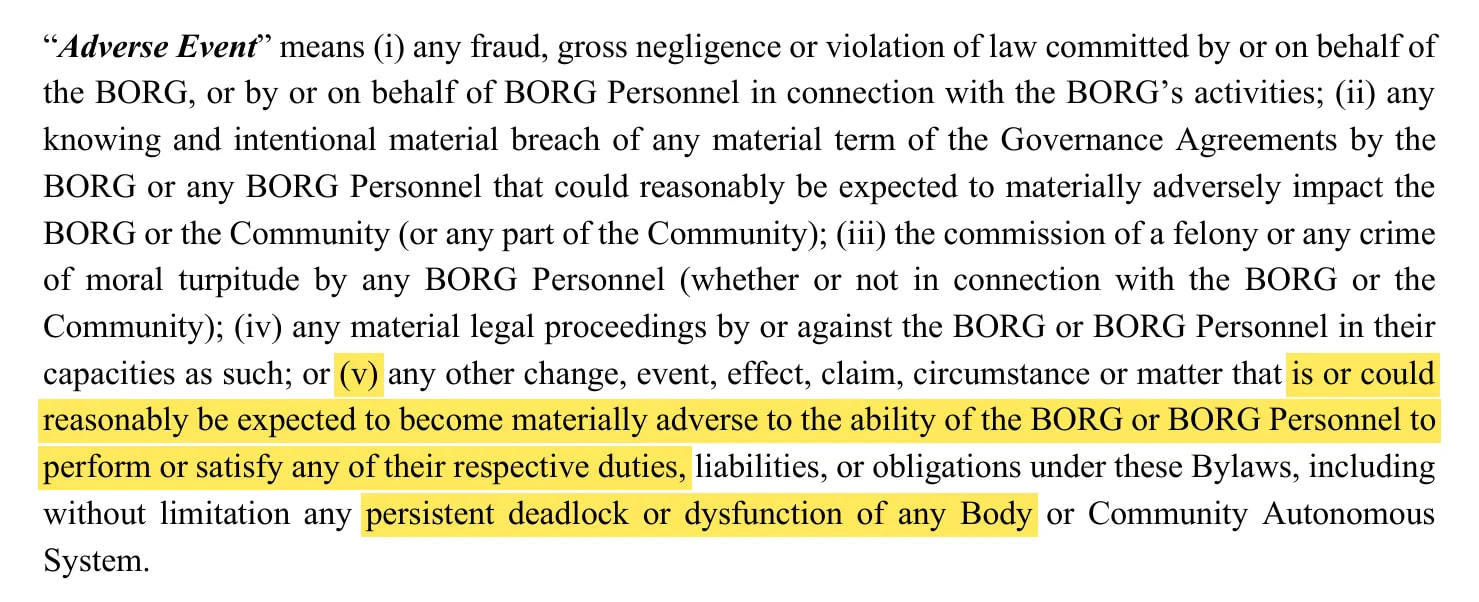
"Adverse Event" means ... (v) any other change, event, effect, claim, circumstance
or matter that is or could reasonably be expected to become materially adverse to
the ability of the BORG or BORG Personnel to perform or satisfy any of their
respective duties, liabilities, or obligations under these Bylaws, including
without limitation any persistent deadlock or dysfunction of any Body or
Community Autonomous System.

Article 2.6.2 also caps the office, barring it from removing, replacing, or directing the Board (Bylaws, Art. 2.6.2, p. 12).

Article 2.6.2: "The Emergency Supervisor shall not have any authority to remove,
replace, or direct the decisionmaking of the BORG, the Board, or the Guardians,
but solely shall have the investigatory and remedial powers identified above, and
solely in relation to the specific Adverse Event in connection with which the
Emergency Supervisor was appointed."

Item 4 nonetheless asks governance to authorize that removal. If the power is needed, then amend the Bylaws. As @0xPhilipp states (several times), this matter must be dealt with under the current structure. Under the current language, it cannot come through an emergency vote, and therefore must be dropped for the time being.

The voting threshold is not the problem

“The majority decides” is the rule, and the threshold was not met. A majority of four is three; A272 got two, and Board action through the multisig must also meet the multisig’s signing threshold (Bylaws, Art. 3.1.3.2, p. 15).

Article 3.1.3.2(a): "At all meetings of the Board, a majority of the total number
of Directors then in office shall constitute a quorum for the transaction of
business and the act of a majority of the Directors present at any meeting at
which there is a quorum shall be the act of the Board, except as may be otherwise
specifically provided by statute or by the Charter."

Article 3.1.3.2(c): "Notwithstanding the foregoing provisions of this Article
3.1.3.2, and for the avoidance of doubt, the Board may take no action which
requires the use of the Stewardship Multisig as a Mandatory Autonomous System
unless approved by at least the number of Directors constituting the minimum
signing threshold of the Stewardship Multisig, such approval being evidenced by
the successful execution of a Stewardship Multisig Proposal."

A272 itself needed 75% to remove a director, but fell short, so its second message lowered the threshold to 0.6. The rule was fine when it was removing a sitting director; only becoming a problem when it blocked another.

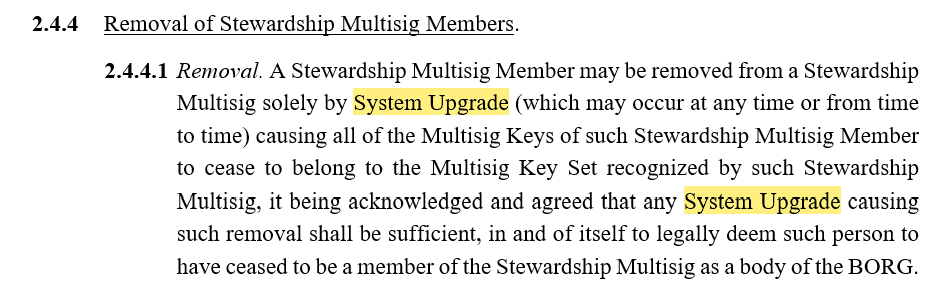
That leaves A272 doing two things at once: remove one member and drop the threshold to 0.6. Removal is only allowed by System Upgrade (Bylaws, Art. 2.4.4.1, p. 9).

Article 2.4.4.1: "A Stewardship Multisig Member may be removed from a Stewardship
Multisig solely by System Upgrade (which may occur at any time or from time to
time) causing all of the Multisig Keys of such Stewardship Multisig Member to
cease to belong to the Multisig Key Set recognized by such Stewardship Multisig,
it being acknowledged and agreed that any System Upgrade causing such removal
shall be sufficient, in and of itself to legally deem such person to have ceased
to be a member of the Stewardship Multisig as a body of the BORG."

MB has voted identically to Philipp on all 119 proposals where both voted; Rose dissenting 11 times, and Vini three. Remove Vini, cut the threshold to 0.6, and two of the remaining three pass anything without any realistic opposition. That’s not simply fixing a deadlock; it’s changing the mechanism to produce a guaranteed result on all future proposals. Vini explained it in his reply:

“A272 was more than a removal. It had two messages: removing me from the member group, and changing the PF DAO threshold to 60%. After the removal that means 2 of 3, so two directors could pass anything on their own.”

The outcome and candidates are seemingly predetermined

Item 1 establishes the Adverse Event, item 3 sets the mandate, and item 4 authorizes the removal it claims to merely investigate:

“Confirm that the Emergency Supervisor may exercise the powers available under Article 2.4.5.4, including instructing the removal of a Stewardship Multisig Member where the Supervisor determines that this is necessary or desirable to resolve the Adverse Event.” — item 4

Article 2.4.5.4 obliges Stewardship members to facilitate a removal an Emergency Supervisor instructs (Bylaws, Art. 2.4.5.4, p. 10).

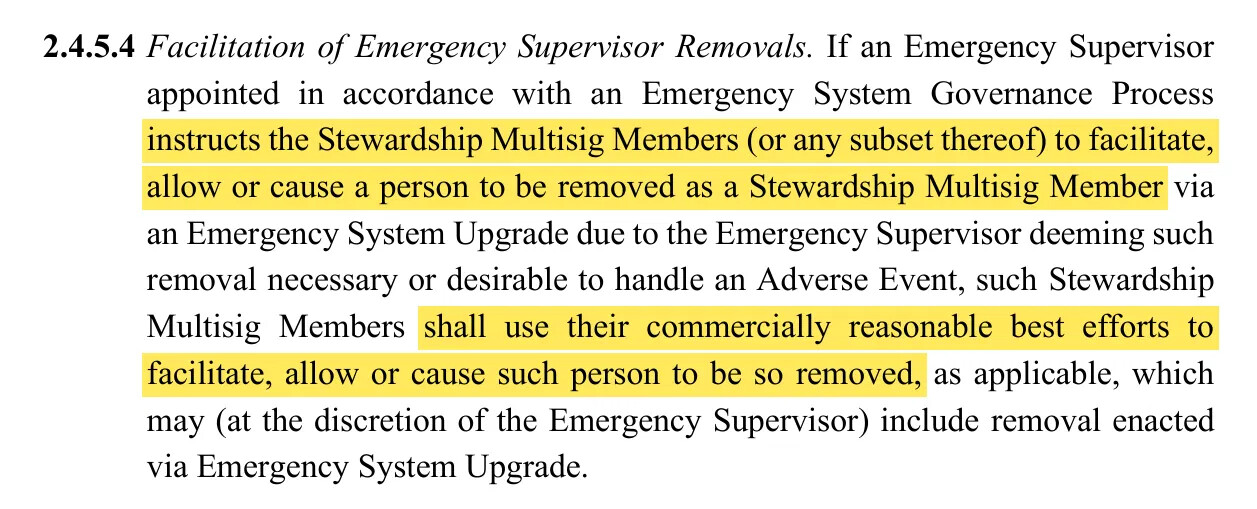
Article 2.4.5.4: "If an Emergency Supervisor appointed in accordance with an
Emergency System Governance Process instructs the Stewardship Multisig Members
(or any subset thereof) to facilitate, allow or cause a person to be removed as a
Stewardship Multisig Member via an Emergency System Upgrade due to the Emergency
Supervisor deeming such removal necessary or desirable to handle an Adverse Event,
such Stewardship Multisig Members shall use their commercially reasonable best
efforts to facilitate, allow or cause such person to be so removed, as applicable,
which may (at the discretion of the Emergency Supervisor) include removal enacted
via Emergency System Upgrade."

The proposal claims “both outcomes must remain possible,” yet item 4 has already authorized the removal — one specific outcome. It says “I am not asking Terra Governance to accept my assessment,” while item 1 asks governance to accept that assessment as fact. And Philipp concedes the Emergency Supervisor “cannot directly remove a Director,” then item 4 asks for the removal anyway. Every assurance of neutrality is contradicted by the proposal’s own text.

The candidates aren’t open either. The opening post presents two names already “acknowledged as potential candidates by three of the four current Stewardship Directors.” A later reply says it proceeds “with only 1” if no third candidate is found, and a later one still says other PF members “already engaged with this process and agreed with the options.” The mandate, the remedy, and the candidate pool are all settled before the community votes.

The conflict and security charges, checked against the record

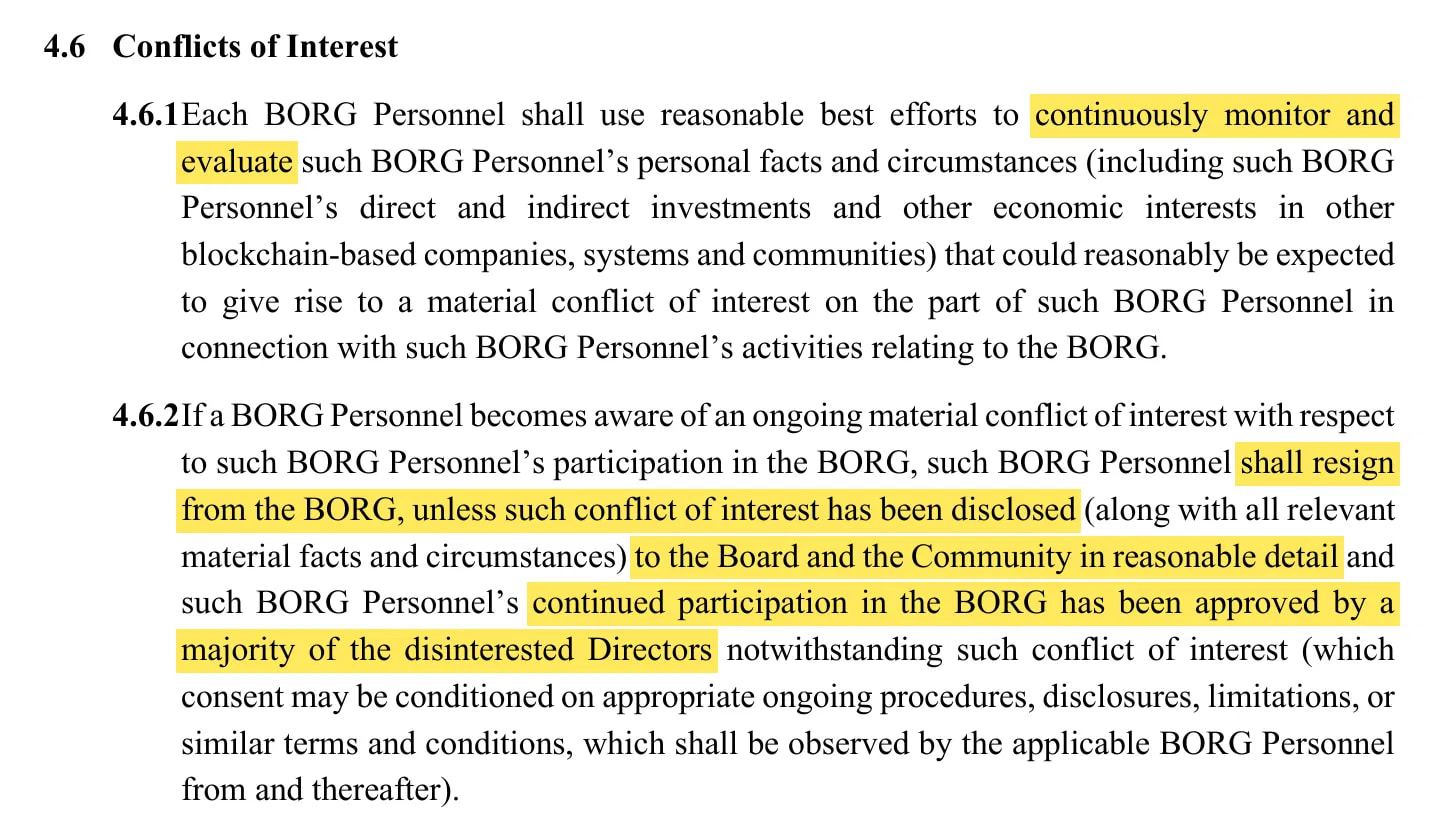
A272 attacks a director over A249, a grant that “paid his own company despite a recognized conflict.” The same record shows the accuser authoring and voting yes on at least seven proposals that paid his own address — $20,450 and 3,500 LUNA — with no on-chain record of disclosure or disinterested-director approval (Bylaws, Art. 4.6.2, p. 23; Art. 3.2.5.3, p. 20).

Article 4.6.2: "If a BORG Personnel becomes aware of an ongoing material conflict
of interest with respect to such BORG Personnel's participation in the BORG, such
BORG Personnel shall resign from the BORG, unless such conflict of interest has
been disclosed (along with all relevant material facts and circumstances) to the
Board and the Community in reasonable detail and such BORG Personnel's continued
participation in the BORG has been approved by a majority of the disinterested
Directors notwithstanding such conflict of interest."

Article 3.2.5.3: "Each Stewardship Multisig Member shall ... evaluate the merits
of each ... Proposal solely in light of the Purposes, Authorized Uses and the
Principles, and, based solely on such evaluation, and without regard to any
personal or extrinsic interest or consideration, determine whether to vote in
favor of such Proposal ..."

A272 also says written security concerns “were dismissed … potentially exposing about $4.4M,” while Philipp’s own later reply says “MB and I were the ones who identified and reported the issue and triggered the process for an immediate Neutron chain halt.” Both can’t stand unqualified. And the Bylaws impose no duty to monitor, prevent, or report security risks (Bylaws, Art. 4.4, p. 23).

Article 4.4: "Without limiting the generality of Article 4.3, none of the BORG,
Directors, Supervisors, Multisig Members or other BORG Personnel shall have any
duty to the Community or any member thereof to monitor, respond to, prevent,
mitigate, or announce any actual or perceived security threat or risk, by using
any Stewardship Multisig or otherwise."

The existing requirement for a Supervisor is being ignored

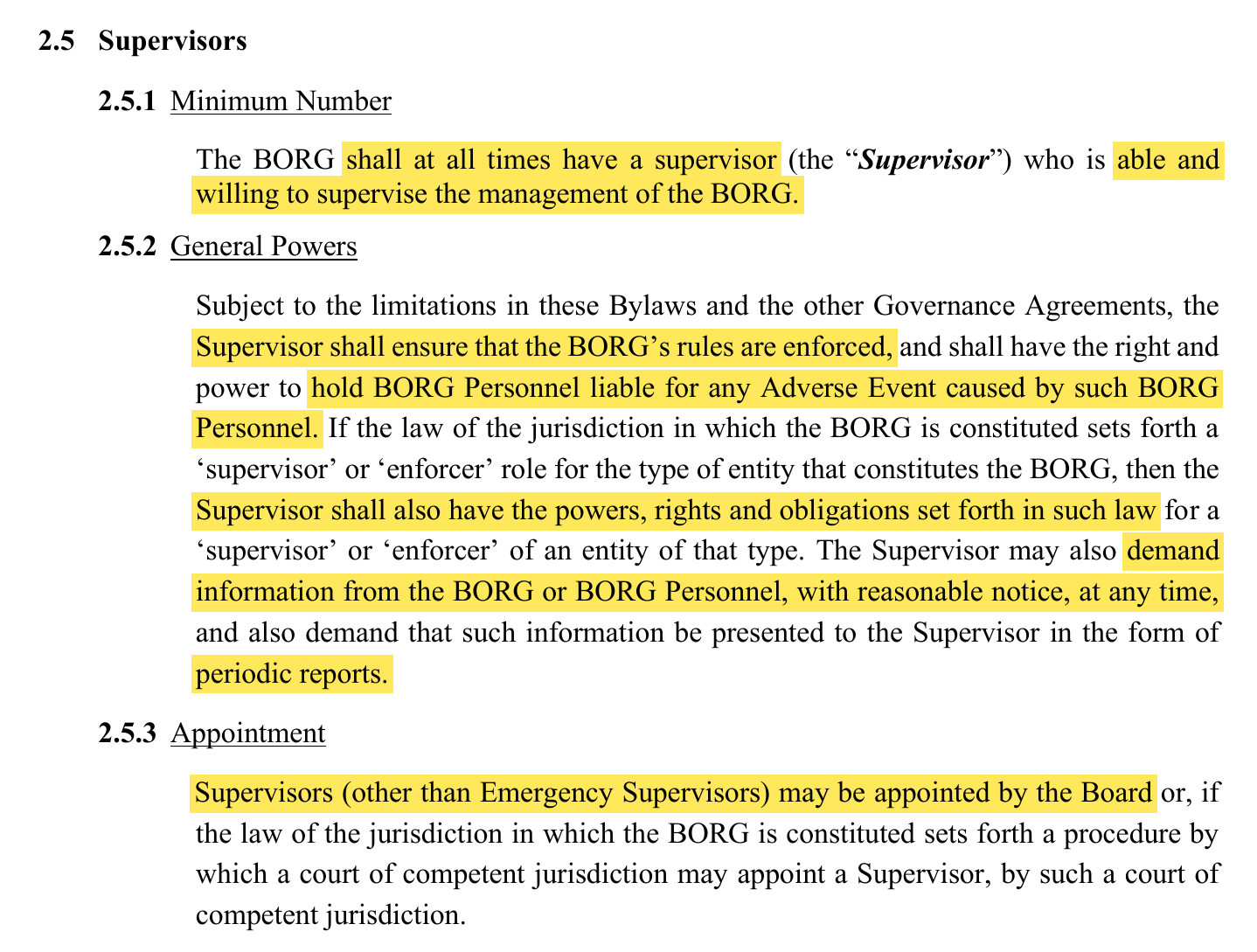
Philipp calls the missing standing Supervisor “a separate governance issue,” and says structural changes “should not be mixed into this process.” Neither holds against the text: the Bylaws require one at all times, with the power to hold personnel liable for Adverse Events (Bylaws, Arts. 2.5.1–2.5.2, p. 11).

Article 2.5.1: "The BORG shall at all times have a supervisor (the 'Supervisor')
who is able and willing to supervise the management of the BORG."

Article 2.5.2: "Subject to the limitations in these Bylaws and the other
Governance Agreements, the Supervisor shall ensure that the BORG's rules are
enforced, and shall have the right and power to hold BORG Personnel liable for
any Adverse Event caused by such BORG Personnel."

No Supervisor has been appointed, despite that “at all times” requirement. Instead the proposal sets its own clock — “maximum of four weeks,” “end of next week,” “with only 1” — while the Bylaws say the Community “may” appoint and set no deadline.

The edits and remaining arguments do not establish an Adverse Event

The remaining justifications don’t establish an Adverse Event. Mandate, contribution, meme coins, “assets on Terra,” “catastrophic liquidity loss,” “Terra Classic” — none of it meets the definition’s material-harm test, much is months old (A249 closed more than three months before A272), and alarmism isn’t an argument.

The Bylaws impose no fiduciary duty to any individual community member (Bylaws, Art. 4.2.3, p. 23).

Article 4.2.3: "As such none of the BORG, the Directors, Officers, Stewardship
Multisig Members, Supervisors, Emergency Supervisors, and other BORG Personnel
are able to, or will, accept, undertake or perform a duty of loyalty to or owe
any fiduciary obligation to any single Community member, sub-group of the
Community, or the Community as a whole."

Conclusion

This isn’t accountability, it’s one person’s personal desire for more power.

Where a rule helps, it bends: a 2–1–1 vote becomes “dysfunction” (p. 30), the power the Bylaws withhold becomes the power requested (p. 12), and the required Supervisor becomes “a separate governance issue” (p. 11). Where it doesn’t, it’s absolute — the 75% threshold is immovable for a removal and negotiable to 0.6 when it blocks one (Art. 3.1.3.2(c), p. 15); 2.4.5.4 binds while 2.6.2’s bar on that same removal is a technicality (pp. 10–12); and the materiality test that demands real harm is satisfied by one vote (p. 30). A rule is only as absolute as its convenience.

Article 2.6.2: "The Emergency Supervisor shall not have any authority to remove,
replace, or direct the decisionmaking of the BORG, the Board, or the Guardians,
but solely shall have the investigatory and remedial powers identified above, and
solely in relation to the specific Adverse Event in connection with which the
Emergency Supervisor was appointed."

"Adverse Event" means ... (v) any other change, event, effect, claim, circumstance
or matter that is or could reasonably be expected to become materially adverse to
the ability of the BORG or BORG Personnel to perform or satisfy any of their
respective duties, liabilities, or obligations under these Bylaws...

Article 2.5.1: "The BORG shall at all times have a supervisor (the 'Supervisor')
who is able and willing to supervise the management of the BORG."

Bottom line: no deadlock, no qualifying Adverse Event, no authority to remedy “dysfunction,” and none to instruct a removal. The required Supervisor was never appointed, the outcome and candidates are predetermined, and A272 pairs removing one member with cutting the threshold to 0.6 so two votes that have never differed control everything. If the question is who should sit on the Board, ask that directly — don’t relabel a 2–1–1 vote as an emergency.

2 Likes

Taking Philipp’s own framing at face value: if A272 is an informational notice and nothing more, then the binding terms who the supervisor is, how many, how they’re selected, the scope, the duration, the pay, and what happens at the end. Are governance’s to set when the on-chain text is published. That’s the only thing I’ve been asking for, and on that we now seem to agree.

On the structure, I’m with David. 2.5.1 contemplates a board that can actually make decisions, and whatever governance ends up appointing, it should leave PF with an odd number of decision-makers 5 or 7 and a proper compliance review behind it. Those are the kind of specifics that belong in the on-chain text rather than in a thread.

I’ll leave the thread there. I’ll read the on-chain text when it’s posted and vote on it like everyone else.

1 Like

Based on our articles of incorporation a supervisor has been set, so let’s not make up stuff.

Please focus on addressing the points I have raised, as they are all very relevant to this issue, and many are quite serious.
You will have plenty of time to publicly attack your colleagues’ character over the coming days/weeks.

Correcting a factually inaccurate statement about PF’s governance structure for readers is not a personal attack.

It’s rather ironic that you accuse me of attacking people’s character when your own post makes much more explicit unbased personal accusations, including claims of “disingenuous conduct,” a “witch hunt,” and a “personal desire for more power.”

I would also remind you of Terra’s Code of Conduct and Community Guidelines, which emphasize respectful discussion, constructive criticism supported by evidence, and avoiding personal attacks.

As for your lengthy post, most of your points are either irrelevant to this proposal or based on your own incorrect interpretations of the Bylaws. I see little value in engaging with a series of misrepresentations that distract from the actual purpose of appointing an independent Emergency Supervisor.

2 Likes

@0xPhilipp, two of your replies answer the same point differently: Vini’s point 4 in post 3, that PF has never appointed the Article 2.5.1 Supervisor.

1. The standing Supervisor

  • Post 5 (16 Oct, 08:28 UTC): “the missing standing Supervisor is a separate governance issue”. You edited post 5 at 08:33 and kept this line.
  • Post 23 (19 Oct, 00:17 UTC): “Based on our articles of incorporation a supervisor has been set”, followed by “let’s not make up stuff”.

Questions

  1. Who is the Supervisor, and can the part of the Charter that names them be shared?
  2. When were they appointed, and have they accepted the role (Article 2.5.4)?
  3. Are they able and willing to supervise the Foundation’s management now, as Article 2.5.1 requires?
  4. On 16 October, was the standing Supervisor missing, as post 5 says, or in place, as post 23 says?
  5. If a Supervisor is in place, has A272 been referred to them, and what was their view?

Article 2.5.2 gives the Supervisor the duty to ensure the Foundation’s rules are enforced and the right to demand information from it and its Directors. The community should know if filled, who holds that role before voting on an Emergency Supervisor.

@rose and @mbaejir, this thread has Philipp’s statements about where you stand, but nothing from either of you yet:

  • Post 1: the candidates “have been acknowledged as potential candidates by three of the four current Stewardship Directors”.
  • Post 13: other PF members “agreed with the options being put forward”.

Could you each say, in your own words:

  1. Do you support Ray Raspberry and Martin as candidates?
  2. Do you support the proposal as it now reads, including item 1’s “serious Stewardship dysfunction”?
  3. Post 23 says “a supervisor has been set”. Who is it? (The questions are in post 26.)

@vini, post 3 doesn’t give your view on the two candidates. Could you add it?

I’m only asking for your own positions, not internal deliberations, which Article 5.1(d) treats as confidential unless the Board decides otherwise. Post 1 asks the Emergency Supervisor to “hear from all four Directors”. Terra Governance voters should be able to do the same before they vote.

There is no contradiction. On 16 October, I had not yet verified the position and treated it as a separate issue. After Vini raised it, we checked the corporate documents and confirmed that a standing Supervisor was appointed under the Articles from incorporation. My second message just makes sure the community is informed that bylaws are being followed properly.

I’m not going to publish non-public corporate details beyond that. The standing Cayman-law Supervisor is also separate from the Emergency Supervisor process under the Bylaws.

Thank you @Rarma! I have no objection to either Ray or Martin if they meet the criteria. I trust that whoever is appointed will look at the full context fairly.

Hi all,

Given community questions about A272, I want to explain why I voted no and where I stand as a Phoenix Foundation Director.

Governance and due process
The Foundation is governed by Cayman Islands law, its Articles of Association and its Bylaws. Both governing documents contain provisions relevant to director removal, and I have not seen a clear explanation of how A272 is consistent with these provisions taken together. I believe independent Cayman legal clarification should form part of any process addressing director removal.

Checks and balances
A272 would have removed a director and reduced the Stewardship multisig from 3-of-4 to 2-of-3, allowing just two directors to authorise actions within its authority. I consider this a significant weakening of our safeguards and favour expanding the multisig rather than concentrating control.

The allegations
I do not accept the allegations as presented or believe they justify removal. This doesn’t mean our procedures have been perfect. Responsibilities, conflicts of interest and accountability all warrant clearer, more consistently applied standards.

Strategic disagreements and procedural shortcomings should be assessed fairly, with evidence, established standards and an opportunity to respond.

The existing Supervisor
The Articles identify an Initial Supervisor. I have contacted parties associated with the initial appointment to confirm whether it remains current and seek clarification on available oversight mechanisms. This should be clarified as part of considering any emergency arrangement.

Adverse Event and independent review
I do not believe a failed vote alone establishes an Adverse Event, but I recognise the serious disagreements within the Board and the risk of ongoing dysfunction.

I support an independent review to establish the facts and identify a constructive path forward, whether through an Emergency Supervisor or another appropriate mechanism.

Any appointment process should establish a clear legal basis, defined powers and safeguards, without predetermining findings or removal. The appointee should be independent, have appropriate legal and corporate governance expertise, and no material conflicts of interest involving the directors or Terra ecosystem teams.

Moving forward
I remain committed to a resolution that respects our governing documents and protects the Foundation, its treasury, and the Terra blockchain.

Alongside my No vote, I shared a working proposal outlining a possible path forward. It was offered as a starting point for collaboration, not a finished solution, and I remain open to other approaches.

My vote against A272 reflects my belief that decisions of this significance must be based on substantiated evidence, fair process and proportionate action, while preserving the checks and balances that protect the Foundation.

1 Like

Hi Rarma,

When Ray and Martin were first suggested, I didn’t have significant objections, and I’m not ruling either out now. However, having looked more closely at the legal and governance questions involved, I think the appointment should be approached with careful consideration. My preference would be someone with relevant legal and corporate governance experience, ideally familiar with Cayman Islands law, though I’m open to other suitably qualified, independent candidates.

As for the current supervisor, the Foundation’s Articles identify an Initial Supervisor, but I’m awaiting their response to confirm whether that appointment remains current. As the Articles haven’t been published, I’d prefer to clarify what information can appropriately be shared before naming them publicly.

@0xPhilipp, thanks for checking. So post 5’s “missing standing Supervisor” was unverified, and your position is that a Supervisor was appointed under the Articles at incorporation (11 October 2024). Rose has since written that “The Articles identify an Initial Supervisor” and that she is checking “whether it remains current” (post 30). She has also asked whether the Articles should be shared before the community decides (post 31).

On the two roles being separate, the Bylaws connect them:

  • Under 2.5.2, the Supervisor “shall also have” whatever powers Cayman law gives a supervisor, on top of its Bylaws duties. Subject to the Bylaws’ limits, it must “ensure that the BORG’s rules are enforced”, can hold BORG Personnel liable for an Adverse Event they cause, and can demand information from the Foundation and its Directors with reasonable notice.
  • 2.6.1 calls Emergency Supervisors “additional Supervisors”. The appointment routes differ, and both roles can act on an Adverse Event (2.5.2 and 2.6.2).

To be fair, the Bylaws don’t require the standing Supervisor to act first, and none of this needs to delay a review of the underlying issues.

Your edit says your second message was to make sure “bylaws are being followed properly”. These can all be answered without publishing a name:

  1. Did your check confirm the Supervisor is still in office, and that they are the Supervisor for Article 2.5?
  2. Has A272, or the Adverse Event in item 1, been referred to them? If not, why not?
  3. Are they independent of all four Directors?
  4. Who checked the documents, and have all four Directors seen them?
  5. Is the decision not to publish, a Board decision under Article 5.1(a), or your own? (Under 3.1.1.2, no single Director can act for the Board. This goes for you too @rose, before you post anything without broader Board agreement)

2.6.1 allows an Emergency Supervisor “solely to the extent necessary or desirable”, so voters should know whether the existing Supervisor has been used before they appoint an additional one.

There is a clear misconception about the role of the standing Supervisor.

Standing Supervisor = ongoing compliance/enforcement oversight.
Emergency Supervisor = temporary investigator/remedial authority for a specific Adverse Event.

The standing Supervisor is not required to investigate or adjudicate this dispute, and their approval is not a prerequisite to appointing an Emergency Supervisor. The Emergency Supervisor is the role specifically designed to independently investigate the Adverse Event and determine the appropriate remedy.

At this point, you are trying to conduct that investigation yourself, but that is exactly what the independent Emergency Supervisor is for.

The reviewer can receive the full legal documents, evidence and context. I’m not going to litigate this through endless forum questions or disclose non-public corporate material to individual users. If you want to apply as independent Emergency Supervisor, apply. Otherwise, let the independent reviewer do the job.

Hello Lunatics, I fully agree with Maxs assessment. A proposal failing to reach the required voting threshold does not constitute a governance emergency. That’s precisely how things supposed to work.

Changing the rules simply because the original outcome wasn’t favorable sets a dangerous precedent.

If there is a genuine adverse event, it should be demonstrated with clear evidence and addressed strictly within the existing bylaws.

Governance rules cannot be respected only when they produce the desired outcome. Terra does not need further concentration of power disguised as an emergency.

I do support Ray Raspberry and Martin as candidates. 3 of 4 directors participated in this process to identify and consider candidates. All 3 directors agreed on their suitability and putting these candidates forward for the community to choose.

Yes, there is serious stewardship dysfunction existing and the circumstances definitely meets our bylaws definition of an adverse event. I support this proposal and its goal, in line with our bylaws, requesting the community to help select one of the candidates identified as our independent emergency supervisory to resolve this impasse.

1 Like

Are you not at all concerned by the concerns raised in prop A272?

@0xPhilipp, yes: “Standing Supervisor = ongoing compliance/enforcement oversight.” That is the whole premise of my questions: is there a Supervisor, and if so, have you used them?

You say the standing Supervisor is “not required to investigate or adjudicate this dispute”. Agreed, it isn’t required to. But it is empowered to. The two roles overlap, and the standing Supervisor’s is the broader one:

  • Standing Supervisor (2.5.2): subject to the Bylaws’ limits, must “ensure that the BORG’s rules are enforced”, can hold any Director liable for “any Adverse Event” they cause, and can demand information and periodic reports from the Foundation and each Director, with reasonable notice, “at any time”. It also has any powers Cayman law gives a supervisor.

  • Emergency Supervisor (2.6.2): can investigate, hold culpable parties liable and seek remedies, but “solely in relation to the specific Adverse Event” it is appointed for. Article 2.6.1 calls it one of the “additional Supervisors”.


Screenshots are from the Phoenix Foundation Bylaws (post 1, Appendix B).

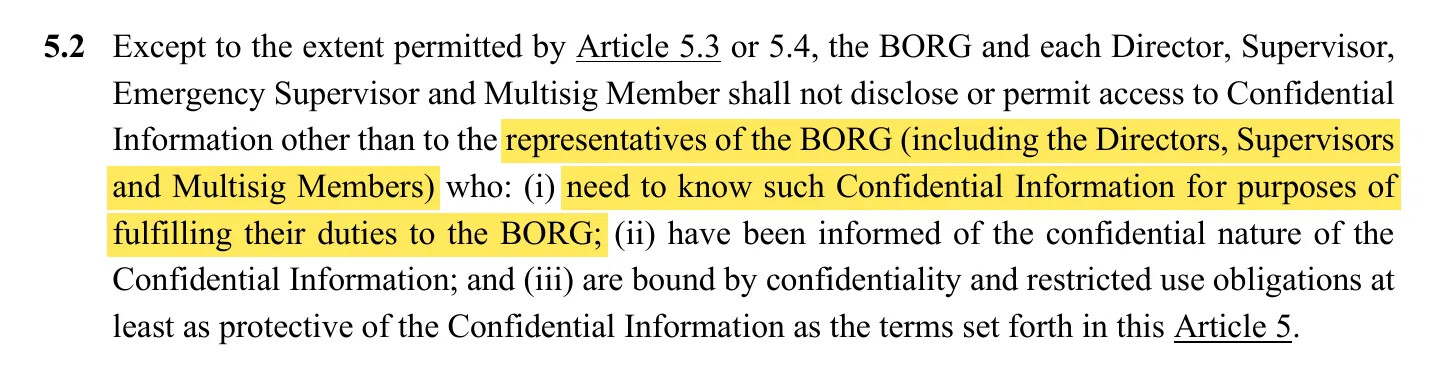
So the Supervisor that Article 2.5.1 says the Foundation must have “at all times” can already do most of what post 1 asks: review the issues behind A272, “hear from all four Directors”, “examine the relevant internal records” and hold a Director liable for an Adverse Event they caused. The “full legal documents” you offer the reviewer can go to it too: 5.2 lets confidential information be shared with Supervisors who need it for their duties.

What an Emergency Supervisor adds:

  • express authority to act and bring claims in the Foundation’s name (2.6.2);
  • the power item 4 asks for, to instruct the Stewardship to facilitate a removal (2.4.5.4);
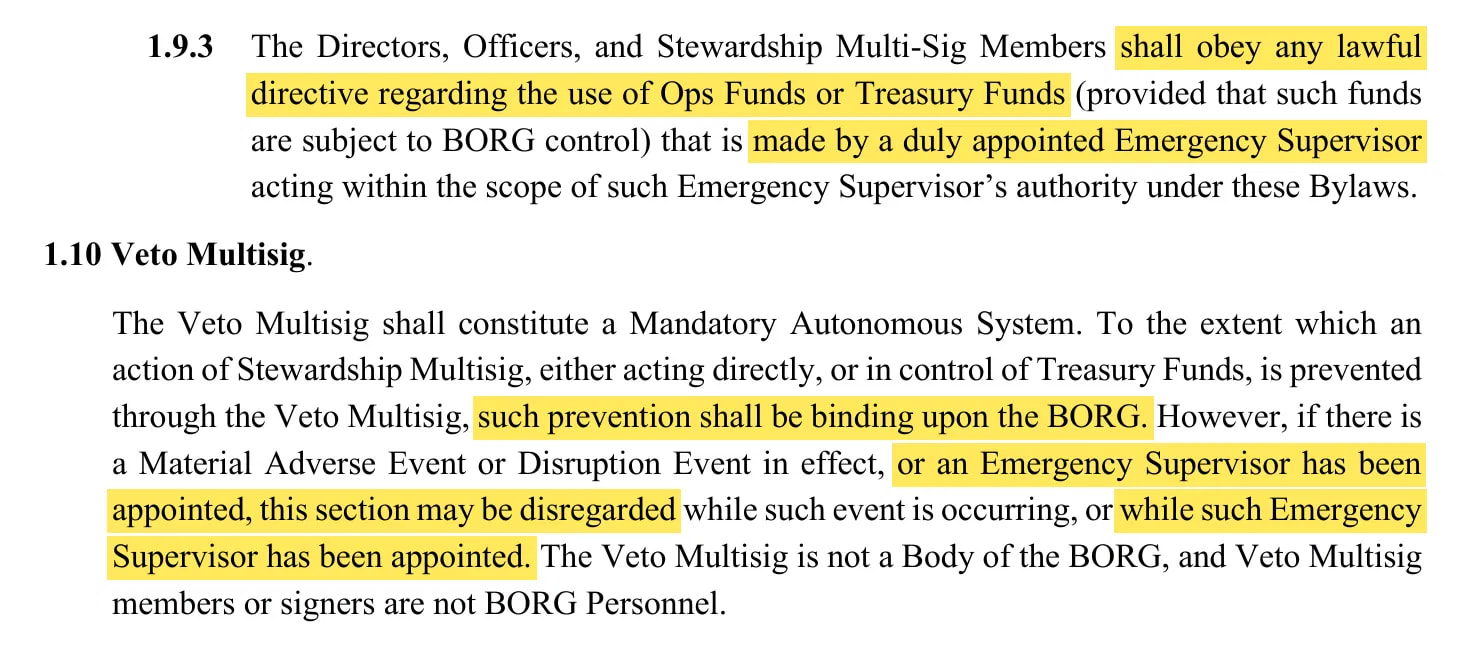
  • lawful directives on the use of Ops and Treasury Funds, within its authority, which Directors must obey (1.9.3);
  • while it is appointed, the rule that Veto Multisig vetoes bind the Foundation “may be disregarded” (1.10).


Yet the proposal skips the standing Supervisor and asks Terra Governance to approve up to USD 10,000 of Foundation funds for an additional one (item 6). Under 2.6.1 an Emergency Supervisor may be appointed “solely to the extent necessary or desirable” to resolve or mitigate the Adverse Event. Voters can’t judge that without knowing whether the Supervisor who should be doing this job now has been asked. Rose has said the Supervisor’s status “should be clarified as part of considering any emergency arrangement” (post 30).

So, before Terra Governance is asked to fund an additional Supervisor:

  1. Post 28 confirms a Supervisor was appointed under the Articles “from incorporation”. Is that Supervisor still in office today, and “able and willing to supervise the management of the BORG” (2.5.1)?
  2. Post 28 also says that on 16 October, the day this proposal went up, you “had not yet verified the position” on whether a standing Supervisor had been appointed. Was A249, A272 or any other matter put to the Supervisor before this proposal? If so, when, and with what result? If not, why not?
  3. Which of the additional powers listed above does this matter need, and why? If the reason is independence rather than powers, 2.5.3 lets the Board appoint a Supervisor itself. Vini proposed exactly that on 16 October: “the board should appoint the permanent Supervisor the bylaws require” (post 3).

None of these needs a document or a name.

The whole Board, not one member

My questions in this thread have been about how the Board works: its alignment, its understanding of the Bylaws, and how the BORG functions within them. What the record shows so far:

  • The Supervisor. No Director has yet confirmed that the Supervisor named in the Articles is still in office. Your account rests on the Articles at incorporation (post 28). As of post 31, Rose was awaiting confirmation “whether that appointment remains current”. MB has not addressed it in this thread. On 16 October, Vini said PF “has never appointed” one (post 3).
  • Conflicts. A272 says Vini voted on A249, which “paid his own company”, “despite an agreed recusal”. You voted yes on five releases of grant milestones, 305,000 USDC in total, paid to the wallet you listed as yours in topic 10 (A116, A175, A209, A215, A271). Each passed on exactly three votes. You did not vote on the Creda and Estima approvals (A190, A266). I can find no 4.6.2 disclosure or recusal record for A249 or for these releases on this forum or in any Stewardship proposal. Every Director has also voted on proposals that included their own pay, which the Board sets itself under 2.2.7 (Rose on A124, Vini on A246, MB on A278, you on A279). Whatever standard A272 relies on needs to be produced and applied to all four.
  • Engagement. Rose and MB first posted in this thread on 19 October, three days after the proposal went up and after post 27 asked for their positions. MB’s reply (post 35) supports the proposal but does not answer post 27’s question on the Supervisor.


Before Terra Governance is asked to declare an Adverse Event and fund an Emergency Supervisor, every Director should be on record on two things: whether the Foundation’s Supervisor is in place, and what conflict standard the Board applies to its own members.

Review all four Directors

Read as written, none of the Directors’ own statements is limited to one member:

  • Philipp describes his role as helping ensure “its Directors remain accountable for the responsibilities entrusted to them” (post 1).
  • MB says there is “serious stewardship dysfunction” (post 35).
  • Rose says conflicts of interest and accountability “warrant clearer, more consistently applied standards” (post 30).
  • Vini trusts whoever is appointed will “look at the full context fairly” (post 29).

Item 1, by contrast, defines the Adverse Event by reference to A272, which post 1 describes as “concerning the continued membership of one Director”. It says nothing about the Supervisor’s status, conflict standards or the conduct of the other three Directors. Because 2.6.2 confines an Emergency Supervisor “solely” to the Adverse Event it is appointed for, anything item 1 leaves out may fall outside the review.

If this goes to Terra Governance, item 1 should define the Adverse Event as the governance of the Stewardship as a whole, and item 3 should instruct the reviewer to examine all four Directors on the same terms, covering at least:

  • whether the Foundation has had a Supervisor “able and willing” to supervise at all times since incorporation (2.5.1), and whether that oversight has been used (2.5.2);
  • every Director’s votes on payments to themselves, their own wallets or their own companies, and any 4.6.2 disclosures;
  • the “established governance and conflict-of-interest procedures” A272 relies on, when they were adopted, and whether they have been applied to all four;
  • the concerns raised in A272, on the same terms as the rest.

Post 1 says: “I will accept the outcome of that process even if I disagree with it.” That commitment should extend to a review of every Director, its author included.

@0xPhilipp, @mbaejir, @rose and @vini: will each of you support amending items 1 and 3 so the review covers all four of you?

Yes or No.

No. I’m not going to support turning this into an open-ended investigation of every Director, every grant and every PF decision ever made. That would completely derail the purpose of resolving the actual governance failure in front of us and make it significantly harder to attract qualified people to serve as Directors in the future.

The Emergency Supervisor should review the full context underlying A272 and the Adverse Event, including the conduct of any Director where relevant and any information necessary to understand that context, which may or may not include specific grants. I have no issue with my own actions being reviewed as part of that.

What is becoming increasingly difficult to ignore is your repeated effort to broaden and complicate this process instead of helping resolve the issue that triggered it. At this point, I think it is fair to ask what your actual objective is here.

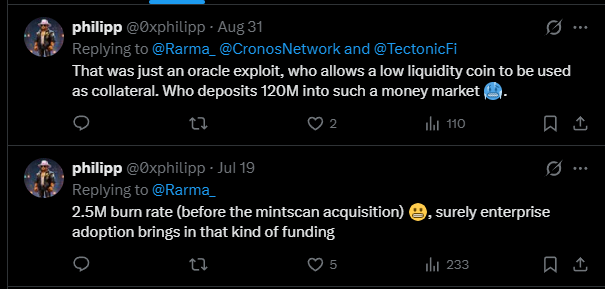
As far as I remember, you have publicly laughed at Cosmos chains failing and users losing money and, apart from a now-deleted ugly unbased statement about me, have had no meaningful involvement with Terra. Given how aggressively you are trying to expand and derail this process, I think questioning your motivation here is entirely reasonable.

@0xPhilipp, post 37 didn’t ask for “every PF decision ever made”.

It listed four things: whether the Supervisor has been in place and used since incorporation, Directors’ votes on payments to themselves and any 4.6.2 disclosures, the conflict procedures A272 relies on, and A272’s own concerns. All four sit inside what you now call “the full context underlying A272”: A272 charges a breach of “established governance and conflict-of-interest procedures”, so whether those procedures exist, and apply to everyone, is that context.

You also say the reviewer should examine “the conduct of any Director where relevant”, and that you have “no issue with my own actions being reviewed”. Good. Under 2.6.2 the reviewer can only act on the Adverse Event the proposal defines, so please write that into items 1 and 3. For example, item 3 could instruct the reviewer to investigate the Adverse Event and the full context underlying A272, including the conduct of any Director where relevant. If that is already your position, adding it costs nothing.

On motives: in post 25 you reminded MaxP that the guidelines call for “avoiding personal attacks”. The same applies here. For the record, I haven’t deleted anything in this thread: my five posts are all on their first version. What I’m asking for is in those posts: one standard for all four Directors, written into the text voters approve.

@rose, @mbaejir and @vini: the question in post 37 is still open for each of you. 3/4 Board members is how the BORG works.

No. The scope of this prop is not going to be changed.

Why are you avoiding the question about your motivation here?

As far as I know, you are neither a LUNA holder nor an active member of the Terra community, while having previously posted a now-deleted personal attack about me on Twitter, so what exactly is driving this level of involvement?

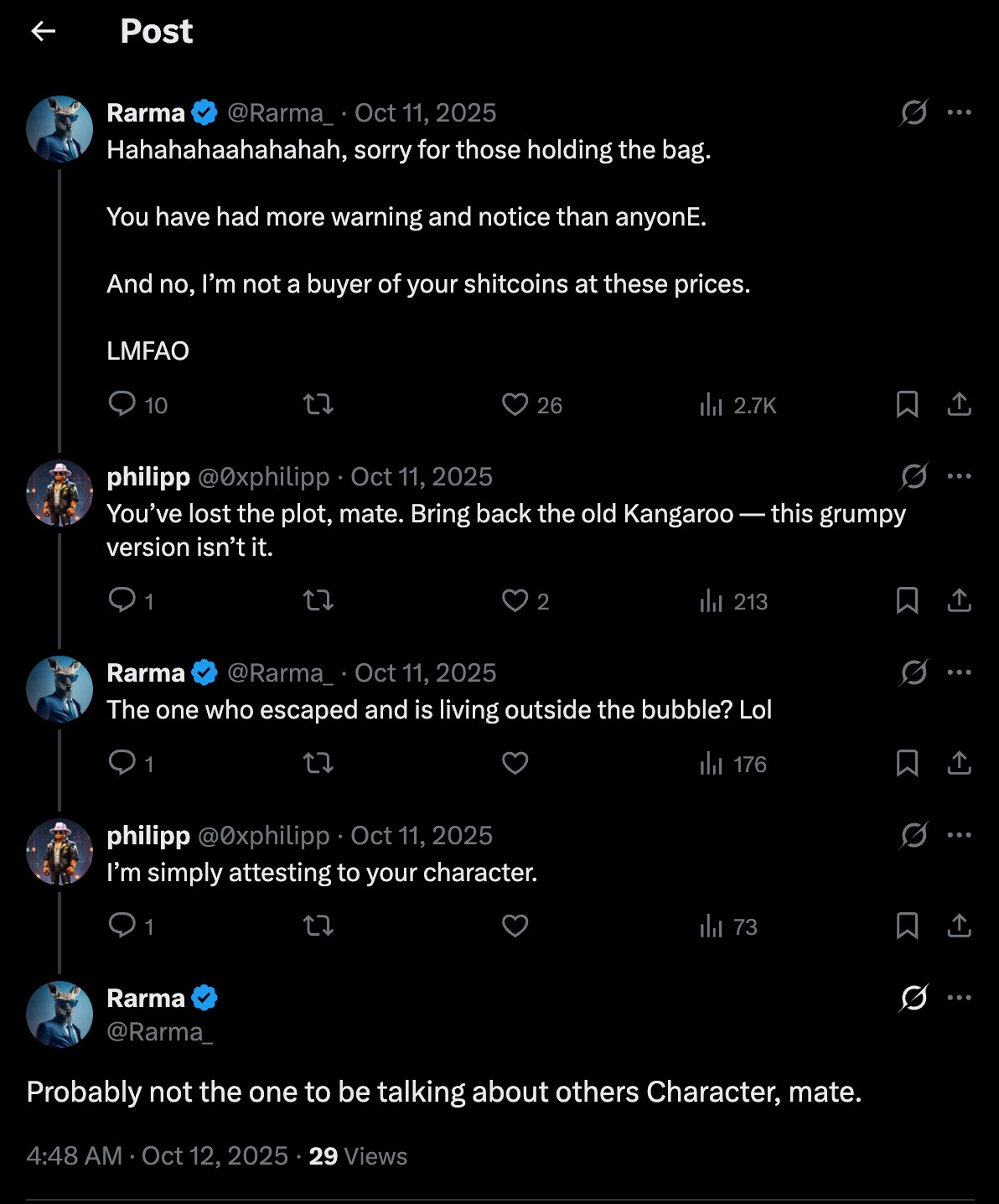
This is not a personal attack, but readers might want to understand who the Person is we are dealing with here and what he says about Cosmos ecosystem: Rarma on X: "Hahahahaahahahah, sorry for those holding the bag. You have had more warning and notice than anyonE. And no, I’m not a buyer of your shitcoins at these prices. LMFAO" / X

I honestly don’t understand why asking questions or making suggestions is seen as an attack. I see a problem that needs a fair solution. The current suggested proposal doesn’t seem to have broad community support, which is why people are exploring alternatives. This shouldn’t be about being with or against anyone.

My suggestion of three independent supervisors, chosen through community governance and not by PF, is about neutrality. It protects the community, but also protects the current directors from doubts about whether the process was fair.

A lot of relevant information isn’t public, so it’s difficult for the community to judge either side fairly. As Rene mentioned, there is already a Supervisor, and Rose is trying to clarify their role and powers. I think we should wait for that reply before jumping to conclusions or deciding what needs to happen next.

We just want transparency, fairness and what’s best for Terra.

1 Like

My suggestion of three independent supervisors

Has anyone put any names forward?

We just want transparency, fairness and what’s best for Terra.

This is what the Emergency Supervisor will be able to provide.

If people are unhappy with PF, they can put up a governance proposal to disband it.

My opinion:

For me, a Director who is aware of these issues but fails to handle them properly is unacceptable.

There were serious failures in assessing ecosystem risks, handling critical information, and fulfilling responsibilities during a crisis. These failures could have exposed approximately $4.4 million in Terra liquidity to risk and have significantly undermined trust at the Director level.

This is unacceptable because it affects not only the community but also Luna’s long-term future. We are already in a very vulnerable position. If another incident like this happens, Luna may not be able to recover.

At this stage, we need Directors who demonstrate sound judgment, transparency, accountability, and the ability to act decisively under pressure. We cannot afford to make the same mistakes again.

Ray Raspberry — A long-time member of the Terra community, blockchain researcher, and investigator.
→ If we choose him, we could improve transparency around the blockchain and fund flows. I’m somewhat familiar with him through some of his posts.
Martin — A long-time member of the Terra community, a Canadian lawyer, and a major DeFi liquidity provider.
→ If we choose him, we could strengthen our legal position. He could provide legal support when needed, as well as contribute liquidity to Terra.
However, I don’t know him personally. I’m willing to take the risk, so I would choose Martin because I believe he could be more valuable for our long-term future. Since he is Canadian, he might also be able to support us when we expand into the US market or explore opportunities related to a potential Luna ETF or similar initiatives.

2 Likes

Just because no names have been put forward yet doesn’t mean we should rule this out. Doing so could discourage potential candidates from even considering it.

If the existing standing Supervisor can handle this fairly and independently, then perfect. But I think we should wait for Rose’s clarification first.

If the current Supervisor isn’t able to cover what’s needed, then we could open a separate proposal outlining the requirements and duties for three independent supervisors, allowing people to apply and the community to choose.

For now, I think the best thing is to wait for Rose’s reply before jumping to conclusions.

@0xPhilipp, you asked about my motivation (post 41). It’s what my posts have asked for: that the Foundation follows its own Bylaws, and that whatever standard is applied to one Director is applied to all four. That includes the concerns in A272, which should be reviewed on the same terms as everything else.

You say I “previously posted a now-deleted personal attack” about you on Twitter, a claim you also made in post 38. In post 25 you reminded MaxP that Terra’s Code of Conduct and Community Guidelines emphasize “constructive criticism supported by evidence” and “avoiding personal attacks”, and you objected to his “unbased personal accusations”. I’d ask you to meet the same standard: share the evidence for that claim, or withdraw it along with the other personal accusations in posts 38 and 41.

Whether I hold LUNA, and an X post from a year ago, have no bearing on whether anything I’ve posted is accurate. The guidelines set no such test: they say “your participation truly counts” and ask that criticism be “clearly backed up by data”. Every point I’ve made links to the Bylaws, a forum post or the chain. If any of it is wrong, say which.

In post 38 you also said widening the review would “derail” this process. Your last two posts turn from the proposal to me.

Where things stand

  • Scope. After post 39, you added “the conduct of any Director where relevant” to item 3 (post 1, edited 19 October). Thank you. Item 1 still defines the Adverse Event by reference to A272, and under 2.6.2 the reviewer can act only on that Adverse Event. MB says “The scope of this prop is not going to be changed” (post 40).
  • The premise. You and MB say the circumstances meet the Bylaws’ definition of an Adverse Event (post 1, post 35). Rose does “not believe a failed vote alone establishes an Adverse Event” (post 30). Vini says “The Foundation is functional” (post 3).
  • The standing Supervisor. The Bylaws require one “at all times” (2.5.1). You say one was appointed under the Articles “from incorporation” (post 28). As of post 31, Rose was awaiting confirmation whether that appointment “remains current”. No Director has confirmed that the Supervisor is in office today, or that it has been asked to act. Vegas suggests waiting for Rose’s answer before going further (post 45).

Before voting, check whether:

  1. the on-chain text keeps item 3’s new wording, and item 1 defines the Adverse Event broadly enough for that review to reach it (2.6.2);
  2. the Board has confirmed whether the Supervisor named in the Articles is in office (2.5.1);
  3. the “established governance and conflict-of-interest procedures” A272 relies on have been identified, and applied to all four Directors.

I’ve said what I came to say. The thread is here for the Terra community to read and decide.

Support for the Emergency Supervisor Proposal

A practical path out of a 2-2 stalemate.

The Phoenix Foundation has a problem it cannot solve on its own. Proposal A272 ended in a 2-2 deadlock among the Stewardship Directors. When a governing body splits evenly on a question about its own composition, the usual tools stop working. That is not a failure of anyone’s character. It is a structural reality. You need an outside mechanism, and the Bylaws already provide one.

Why this proposal fits the moment.

This is not a power grab dressed up as an emergency. The Emergency Supervisor role exists for exactly this situation a specific Adverse Event that the Foundation’s internal bodies cannot resolve. The appointment is temporary, capped at four weeks, and limited to this single matter. The supervisor does not take over the Foundation. They investigate, hear from all four Directors, review the records, and determine how to resolve the deadlock. That is a narrow mandate with a clear exit.

The standing supervisor question deserves a straight answer.

You will see questions about whether the existing standing supervisor should handle this first. Fair point. The Bylaws do give that role broad compliance oversight. But the Bylaws also treat the Emergency Supervisor as an additional role with distinct powers the express authority to act in the Foundation’s name, the power to instruct a Stewardship removal, and the ability to issue binding directives on Ops and Treasury funds while appointed. The standing supervisor is not required to adjudicate this dispute, and waiting for that role to act adds delay without adding clarity. The Emergency Supervisor is the instrument built for independent investigation and remedy. Use it.

The community picks the person, not the Directors.

This is the part that matters most. The proposal does not let either side of the deadlock choose the referee. Candidates are discussed openly, and the community selects the supervisor through governance. The eligibility bar is strict: no financial ties to the Foundation or any Director, no pending funding applications, no recent governance role, and no public position on A272. Two names have surfaced, Ray Raspberry and Martin, both long-term Terra community members with relevant experience. Three of the four Directors have acknowledged them as potential candidates. That is not an endorsement. It is a starting point for community review.

What you get by supporting this.

  • A time-limited, independent process instead of an endless forum loop.
  • A decision made with full access to the legal documents and internal records.
  • A supervisor accountable to Terra Governance, not to either faction inside the Foundation.
  • A clear precedent: when the Foundation cannot govern itself, the community steps in through the Bylaws, not around them.

The alternative is to leave a 2-2 deadlock unresolved and hope it sorts itself out. It will not. Deadlocks do not age well. They harden. They breed suspicion. They turn every routine decision into a proxy fight. You have a Bylaws mechanism designed for this exact scenario. It is temporary. It is independent. It is community-controlled. Support the proposal completely and let the process do its job.

1 Like

Excuse me, I had to step in here. Because some of you seem to believe as if a 50% vote is a deadlock. It’s just a failed vote. Treshold for passing in a 3 out of 4 member system is 75% . This is arguably higher than a 3 out of 5 (60%) or a 4 out of 6 member (66%) system.

However, this is the only system that works in a 4 member DAO and if you wish to reduce that treshold then you need to add members. Reducing members to 3 is not an option due to the risks of 2 people “deadlock” it carries. And as such I would have also voted No on proposal A272. 2 people can essentially win every proposal, making the third member and hence the DAO irrelevant (u might aswell just hand them the treasury on silver platter). That is the real danger that many of you seem to miss.

So I consider the appointment of a supervisor irrelevant to the real discussion at hand because it doesn’t solve the problem. Which there isn’t actually. It’s just some are displeased with the outcome of proposal A272 . And as a long term Luna hodler, I am definitely not.

1 Like

You raise a fair technical point, PhoenixPinion. A 2-2 vote is a failed vote under the current rules. The 75% threshold is deliberate, and I agree we should not lower it. Changing the membership structure carries real risks.

But here is where I see it differently. The question on the table is not whether the threshold is correct. The question is what happens when a failed vote leaves the Foundation unable to function. You call the supervisor irrelevant. I call it the only tool we have that does not require rewriting the rules or reshuffling the Directors.

Think about the practical reality. The Foundation has four Directors. Two support A272. Two oppose it. That split will not break on its own. Every future proposal touching governance or composition will hit the same wall. You said it yourself: reducing members to three is not an option. Adding members takes time and consensus. Lowering the threshold is a bad idea. So what is left?

The Emergency Supervisor does not change the 75% rule. It does not shrink the board. It does not hand anyone the treasury. It creates a temporary, independent process to resolve this dead end. Four weeks. One matter. A supervisor chosen by the community, not by either faction. That is the narrowest possible intervention.

Passing this proposal is the only way forward that respects the Bylaws as they stand. Reject it, and you are left with a failed vote and no mechanism to move past it. The deadlock stays. The suspicion grows. Routine decisions become proxy fights. You said the real discussion is about the threshold. Fine. But you cannot have that discussion while the Foundation is stuck. The supervisor clears the path so that discussion can happen.

Support the proposal. Not because the threshold is wrong. Because a failed vote with no exit is worse than a temporary referee with a clear mandate.

You’re incorrect about every future proposal hitting a wall, because some have already passed just now. Proposal A272 failed because it was a terrible proposal. Not because there weren’t worthy points raised, but because it would have changed the foundation to a risky 3 member setup. The proposal was not just about removing Vini, it was about reducing the treshold from 3 to 2 and making the 3rd remaining member irrelevant.

Sorry for seeing through everything guys. It’s not my fault my mommy gave me such good DNA

1 Like

PhoenixPinion, your arithmetic is right. Your conclusion is where we part ways.

The 75% threshold in a four-member body is not an accident. It protects the DAO from two people capturing every outcome.

But here is the operational fact you keep sliding past. A failed vote is a static event. A 2-2 split on a composition question is not static. It repeats. Every proposal touching governance hits the same wall. Every funding decision becomes a proxy fight. The Foundation stops functioning as a decision-making body. That is not “some are displeased with the outcome.” That is a structural fault.

You call the supervisor irrelevant because it does not solve the threshold problem. Correct. It does not change the 75% rule. It does not shrink the board. It does not touch the treasury. What it does is narrower and more useful it creates a four-week, community-selected process to break the procedural block so the threshold debate you want to have can actually happen on a functioning Foundation.

Here is the technical point. The Bylaws define the Emergency Supervisor as a remedy for a continuing Adverse Event that the internal bodies cannot resolve. A 2-2 deadlock on composition is not a policy disagreement anymore. It is a continuing inability to govern. The supervisor investigates, hears all four Directors, and issues a determination. That is not a workaround. That is the mechanism the rules already provide.

Passing this proposal is the only path that does not require rewriting the rules you just defended. Reject it, and you keep the threshold, keep the board size, and keep the deadlock. You lose nothing by letting an independent referee clear the block. You gain a Foundation that can actually vote on the next thing.

Support the proposal. Keep the 75%. Use the tool built for exactly this situation.

2 Likes

Hello everyone,

I asked on Telegram why not 5 Stewardship Directors instead of an Emergency Supervisor. Philipp’s answer was that accountability has to come first, otherwise we’d be entrenching the dysfunction. I agree accountability comes first. I just don’t think it’s one or the other, and I’m clearly not the only one thinking about board size here: defi_patriot and David mentioned 5 or 7, and Rose said she’d rather expand the multisig than concentrate it.

The way I see it, the Emergency Supervisor looks into the A272 concerns first, hears all four Directors and reports back. If someone has to go after that, the decision comes back to Terra governance with the report in hand, and with a replacement on the same vote, like defi_patriot suggested. In the meantime we start an open process to get to 5.

Adding seats doesn’t shield anyone from the review. It just means that once it’s done, we’re not one disagreement away from another 2-2, and we don’t go down to 3 either.

@cryptobull growing the board isn’t rewriting the rules, the Bylaws already tie the number of Directors to the multisig. It does take time and consensus, which is exactly why it’s worth starting now and not after.

The difference between me calling this a witch hunt and you tastelessly attacking the character of your colleague in public is that I provided evidence to support the claim.

You haven’t even attempted to engage in any discussion or give a constructive response to anything. So far, all I have seen is a whole lot of excuses being made, people being told “you don’t know what you’re talking about (just trust me bro..)”, moving the goal posts by making additional accusations when previous ones were shown to be invalid according to your own bylaws, or that you yourself are guilty of the same thing, and a couple users who just happen to be on your payroll jummping in to redirect or to repeat the same nonsense that has already been addressed, both here and on Telegram.

So again, I would appreciate if you could find the time in your no doubt extremely busy schedule to address the comments in my original post.

Terra should fully reject this attempt at governance capture by a financially interconnected group

The most relevant questions here are: who can authorize spending, who benefits from it, who controls implementation of it and whose consent can be ignored. The same few connected individuals occupy these functions

Few here seem to understand the implications of these decisions, so I’ll outline them:

  1. A272 seeks to reduce the threshold from 75% to 60%. Today, Philipp and MB need Rose or Vini to approve proposals. With 3 equal remaining seats, they would only need each other to pass proposals

Rose would therefore remain a director while losing all ability to stop unreasonable decisions. Keeping 1 (potentially) dissenting person in the 3rd seat is not a safeguard against anything if their consent is no longer needed

In the past, a proposal could be refused on the basis of unreasonableness (as with the original 150K Estima request). Now, it cannot

  1. Philipp and MB’s long term alignment and commercial relationship must be critically assessed:

In all 119 proposals where Philipp and MB voted, both voted YES: Voting history

Their connection involves money. Self-voted distributions to Philipp, MB and Rebel by themselves show long term commercial interests among people participating in foundation governance, review and advocacy. Example: distribution transaction.

Given the past, they should be considered one financially aligned voting bloc

  1. Even more critically, Philipp has consistently retained, reassigned and exercised authority he stated would be handed back

For example, his TLA proposal dated 12 August 2024, archived in the original Phoenix repository, states:

“Contract Admin will be transferred to PD Stewardship after 1 month.”

“Ownership transferred to PD Stewardship after 3 months.”

Exact wording in the original GitHub repository

While subsequent transactions show continued control and the exercising of control:

8 October 2024: his configuration wallet reassigned the Treasury configuration role to itself, after assigning it to the board the previous day. Transaction

1 October 2025: that wallet changed the registry’s fee recipient from the board to the Eris fee account. Transaction

23 September 2026: the Treasury’s migration administrator moved between the two Philipp controlled Eris wallets identified in his own launch document, while stewardship was not made administrator: Transaction

The original TLA handover did not happen. Later Treasury transactions show how those same wallets also exercised authority over Foundation infrastructure

All of this, as well as multiple similar incidents, are fully on record in the original statements, wallet ownership records and transactions

This is not arbitrary, it allows the theft or loss of all PF funds via contract change

Long term financial interests, voting influence, misrepresentations and improperly retained technical control must all be examined together

  1. The emergency supervisor proposal now contemplates a removal instruction without a binding replacement or transition to a structure that prevents that same concentration

It’s also worth noting that the foundation continues to operate just fine: failure to approve the removal proposal did not create any operational paralysis


The practical response, given the original reasons for setting up PF, should be:

  • Fully reject any transition that makes Philipp and MB sufficient authority to approve proposals alone

  • Always require financial relationships and beneficiaries to be disclosed in future

  • Complete stated handovers of technical authority from 2+ years ago that was retained and utilized

  • Supervisors suggested on the basis of long term friendship (Ray and Martin), who were both contacted in advance by Philipp, as above, must be rejected

They must be independent of friendship, financial interests and also examine proponents conduct under the same standards they invoke against others

Impartial scrutiny must be directed at directors payments, approvals and retained powers

From a high level, recent actions directly oppose the stated reason PF was setup

Terra and PF governance must always be able to refuse self-dealing and unilateral control

Proposals should be judged on whether they preserve this ability to be fair, or remove it

Right now, there is a persistent attempt to remove the need for any consenting participant outside of the Philipp-MB financially aligned voting bloc

Documented improper retention of administrative authority by Philipp makes promises of “accountability” and “reversals” later completely inadequate

Given how far this has gone in the direction of governance capture, I’ve preserved all records for legal counsel. Those seeking expanded authority in opposition to the purpose of PF and the Terra community in general should expect their interests, representations, approvals and conduct to be examined in future

In short: I oppose this appointment package unless all protections are first secured

The Terra community should never authorize a process that can leave a long term financially connected and self-dealing pair sufficient to approve proposals alone

Before anything else, please disclose your identity and any potential conflicts of interest, including any relationships with current PF Directors. Given the seriousness of your accusations, transparency should apply to you as well.

As A272 makes clear, I have serious and longstanding concerns about the current Board’s ability to act in accordance with its mandate and Terra’s best interests. These concerns are supported by internal discussions.

The TLA contracts remain under ERIS administration because ERIS continues to develop, maintain and operate them. Given my unresolved concerns about the current Board, ERIS Team has not considered transferring that authority appropriate. This is not something I am trying to conceal, and the Emergency Supervisor is welcome to examine it alongside everything else.

Your accusation of coordinated voting is baseless. There is no voting agreement between MB and me. Reaching the same conclusions independently does not constitute coordination or governance capture. Similar accusations have already been made internally, and I welcome an independent Emergency Supervisor examining them alongside the underlying evidence. Serious allegations of this nature demand serious evidence, and if they are found to have been made in bad faith, that should carry consequences as well.

Invoking legal counsel and suggesting consequences for those supporting this proposal appears intended to pressure the governance process toward your preferred outcome. That is a dangerous precedent for Terra Governance, particularly when the proposal seeks nothing more than an independent review of the Foundation’s internal situation and a remedy to resolve it.

The proposal seeks independent scrutiny, not immunity from scrutiny.

Nothing in this proposal predetermines the final governance structure. If the Emergency Supervisor concludes that a five-member Board with a 3-of-5 threshold is the appropriate solution, that recommendation can be brought forward. The purpose is to establish an independent process capable of reaching conclusions based on evidence, rather than allowing those currently involved in the dispute or those looking from the outside with personal agendas to dictate the outcome.

It is increasingly concerning how much effort is being directed toward preventing that independent review from even beginning. This raises serious questions about why a process intended to establish accountability is being met with such resistance. And serious substance from A272 about chain and user funds safety is ignored.

This will be my final response on the matter, due to legal threats made. Constructive discussion appears to have run its course, and I intend to submit the proposal on-chain in the coming days so that the Foundation can move toward resolving these issues and functioning effectively again.

Validators know who has been here and fighting for Terra and who wasn’t. Don’t let Terra become Terra Classic.

2 Likes

You reply confirms the central problem:

You believe your own personal judgment entitles you to withhold powers after publicly committing to transfer them

Your own TLA proposal specified transfer of administration after one month and transfer of contract ownership after three months

It contained no condition requiring the board to retain your confidence

Identify the decision authorizing departure from these terms:

  • who approved it?

  • under what authority?

  • when?

Your reply supplies a retrospective excuse for withholding control, 2 years after the fact. But it supplies no authorization and no transparent declaration at the time

You exercised these powers frequently. The record includes changing the registry’s fee recipient from Stewardship to ERIS and,separately, moving Treasury migration administration between ERIS wallets

Collective oversight is non-existent if the person being overseen is misrepresenting control handovers and taking personal decisions about who receives control


Your denial of voting coordination also deflects from the points raised

A272 expliclty proposed converting the board to a 2 of 3. You and MB supported it. It’s effect would be to make 2 approvals sufficient, despite your ongoing financial relationship (which is proven onchain), without requiring anyone outside your pairing to consent

Even in a situation where there is not coordination, there is no safeguard here against misuse


The suggestion is simple: will you make it a binding condition that any removal that does occur is only done so with an approved arrangement preventing you and MB becoming sufficient authority alone

I support investigation of every director. This involves payments, financial non-disclosure, performance, conflicts, misrepresentations, withheld control, security decisions, retained powers and more. This includes you

Demands for identity and appeals to loyalty have nothing to do with the essential facts: your published commitments, your documented financial relationships and payments, their related financial non-disclosures, nor the effect of A272

You are asking the community to blindly trust a future process that could remove a director, wile offering no protection against you and MB

All while overtly defending your own decision to withhold admin/ownership rights despite your public commitments, without identifying any approval or disclosure changing those commitments

Put your own conduct within the same explicit review mandate

Validators should fully reject this package before sufficient safeguards are in place

You never had the right to make handovers conditional on your own approval of the people who were elected to oversee you

The accountability relationship is reversed here: the person retaining power cannot reserve the right to decide when oversight is acceptable

2 Likes

I couldn’t care less about such a clause. I have not taken a single action that I believe other independent, Terra-aligned Directors would not have supported. (Including putting up A272)

What I will not accept, however, is a governance structure that effectively grants individual Directors veto power or permanent job security. That was essentially the outcome of Rose’s alternative proposal, previously shared publicly in a community group but since made private, which would have further entrenched both Rose and Vini and made future accountability nearly impossible.

The reason I insist on separating removal from the appointment of new Directors is simple: no reasonable candidate would want to be dragged into an ongoing governance dispute.

We have already approached two highly qualified potential Directors, including both new and former contributors, to bring fresh perspectives and experience to PF.

To address concerns about a temporary 2-of-3 multisig, I am willing to make a legally binding, off-chain commitment to vote only No or Abstain during that period, except on proposals necessary to onboard the new independent Directors. I am already KYC-verified, so I have no issue formalizing that commitment.

But the two processes must remain separate. New Directors should join to help build PF’s future, not be forced to take sides in a dispute they had nothing to do with.

2 Likes

“With all due respect, who exactly is “we”?

You are asking the Terra community to rely on another future commitment while refusing to identify what authorized your departure from previous commitments

Again, your 2024 TLA proposal specified administration transfer after 1 month and ownership transfer after 3 months

Two years later, your explanation is that you personally considered the board unsuitable

Who authorized you to replaced the published handover terms with your own personal opinions?

Name the decision, the approving authority and the date it happened

This, among many other documented issues, are all unanswered and have been repeatedly deflected by you

Your latest proposal repeats the exact same dependency: remove an existing safeguard now, then rely on your future conduct during a supposedly “temporary” arrangement. The exact same sequence that you did not honor previously

A restriction on how you promise to vote (with a proven track record of not keeping your word) is not the same as a restriction on what you can authorize

A promise about how you will exercise power is not a limit on the power itself

Onchain governance exists specifically to prevent the possibility for misuse of power, before it happens

Meanwhile, it has been recorded that you have suspended several critics for “dissent” on an open governance forum

Governance loses all credibility the moment disagreement is censored at the same time proponents seek to push through highly contested props. Open discussion is a community good, in the Terra community’s best interests

Censorship in the context of governance capture is significantly worse

You obviously cannot ask for “scrutiny” while excluding those who challenge your proposal and refusing to answer any direct questions or take any direct accountability for unfulfilled commitments

Strong protections must be put into a proposal before asking for more power:

  • An approved transition that prevents you and MB becoming sufficient authority alone
  • Independently assessed replacement candidates, with financial/personal relationships disclosed
  • Completion of multi-year outstanding technical handovers
  • Moderation independent of everyone involved in these conflicts

It should go without saying: another future promise does not resolve unfulfilled commitments

Produce the exact authorization you had to capture administration / ownership rights long term, or complete the full handover now

Put new safeguards in new proposals before asking the Terra community to surrender existing ones

3 Likes

Why not give any new dao members the directive to abstain from this particular dispute? That seems like the obvious solution.

Also I’m still waiting for you to address my original post, all of which is directly relevant to this discussion regardless of how many times you suggest it isn’t for some honestly confusing reason.

It is interesting that people with an axe to grind are hiding behind anon accounts. I have no issue sharing thoughts in public.

Part of the Phoenix Foundation proposal A272 is about the following issue (an issue which the detractors continue to ignore):

Risk Management / Trust: Serious failures in the handling of material ecosystem risks. Written security concerns about Astroport’s dependency on Neutron governance were dismissed days before that risk materialized, potentially exposing about $4.4M of Terra liquidity. Material information concerning Astroport was also held through private communications without being equally shared with other Directors while a fork or takeover was being discussed. The combination of risk judgment, information handling and stepping away during the incident has resulted in a material breakdown of Director-level trust.

The member of PF who should be taking the lead on chain/protocol security, indeed took a $900K grant for these very things - missed an important vulnerability. This is certainly something which I would like to see an Emergency Supervisor investigate fully.

It seems appropriate to remind everyone of the following community pool grant: SCV - Terra Security Expansion Program Proposal.

This was a Terra governance vote on Terra 2 in December 2022, where SCV was awarded $900K worth of LUNA from the Terra community pool. I think it is reasonable to ask SCV (Vini) to address these points:

  1. Where is the published security research and vulnerability reports produced under this programme?

  2. Has there been an IBC Incedent management report from SCV (regarding the Axelar asset exploit)? What has been the published learnings?

  3. Please explain how the $3M loss during the IBC Incident could happen under SCV’s watch?

  4. What open-source security tooling has been developed or maintained?

  5. Please provide a summary of Terra projects that received the promised free security services.

From the Original SCV proposal:

(A) SCV would continue to disclose vulnerabilities and interact directly with protocols and their security owners to reduce risks and working on remediations when necessary. Researching results would be published in the form of blogs posts write-up or and vulnerability reports content on SCV’s public Github repository.

(B) This proposal aims to increase our reach, particularly in other areas including in-house opensource security tooling, security monitoring of the chain and security research.

(C) That being said, if this proposal passes, SCV would be able to scale its operations at Terra as described above and provide these following services, free of charge, to each live project related to Terra.

Penetration testing on Web and APIs → We would provide continually security assurance and recommendations on dapps and APIs. SCV would cover all public CVE’s and common exploits based on each technology;

APIs/Backend Code Review → We would code review backend implementations and APIs middlewhere integrations to ensure there’s no risks involved. GitHub/Gitlab monitoring → Whenever there’s a wrong commit that exposes sensitive content, leading to a risk to the protocol, owner or user, SCV would be the first to know and report;

Security Assistance (vCISO) → We can help with a security related questions and requirements when prototyping an application or an implementation; We can provide guide along the process to ensure all risks and issues are identified in earlier stages;

CW Contract Checks → While we can’t comprehensive audits contracts on-demand, we are able to assist with small modifications and security sanity-checks specially prior audits.

OSINT → SCV would watch for our open source intelligence flow and act accordingly on each event. These events can be anything with a risk attached to it, ie: password leaks, new sub-domain added, etc.

References:
PF prop A272 - DAO DAO
Original $900K SCV proposal - https://common.xyz/terra/discussion/7889-scv-terra-security-expansion-program-proposal
SCV - Terra Security Expansion Program Proposal - https://analytics.smartstake.io/terra/proposal/3534

Just a reminder that participation here is entirely voluntary. Other members are not obligated to reply. Please refrain from repeatedly tagging or prompting individuals for a response. This goes for anyone else here too.

1 Like

I would just like to reiterate Max’s point again. Essentially, there is no real deadlock that causes the BORG to no longer be able to function (and hence require an Emergency Supervisor to intervene). The terms for Adverse Event have unfortunately not been met. Essentially, nothing changed since after A272 except a lost vote which tried to remove a director and change the setup from 3-4 to 2-3 (multiple things at once).

These are the rules of the game. You must first complete level 1 before you can continue to level 2. Level 1 is Adverse Event must be triggered.

Are you just looking at the A272 vote? Or do you have anything to say about the issues raised? Quite concerning imo. I’d imagine prop will go on-chain later this week.

System.“Adverse Event” means (i) any fraud, gross negligence or violation of law committed by or on behalf of
the BORG, or by or on behalf of BORG Personnel in connection with the BORG’s activities; (ii) any
knowing and intentional material breach of any material term of the Governance Agreements by the
BORG or any BORG Personnel that could reasonably be expected to materially adversely impact the
BORG or the Community (or any part of the Community); (iii) the commission of a felony or any crime
of moral turpitude by any BORG Personnel (whether or not in connection with the BORG or the
Community); (iv) any material legal proceedings by or against the BORG or BORG Personnel in their
capacities as such; or (v) any other change, event, effect, claim, circumstance or matter that is or could
reasonably be expected to become materially adverse to the ability of the BORG or BORG Personnel to
perform or satisfy any of their respective duties, liabilities, or obligations under these Bylaws, including
without limitation any persistent deadlock or dysfunction of any Body or Community Autonomous
System.

We are going by the law so we must make sure we actually follow the law. Only when this is triggered may an Emergency Supervisor be appointed by the Terra Governance system. There is no clear definition of “deadlock” in the papers. This is the only time deadlock appears in the bylaws. You have all simply agreed that we are in the deadlock situation, and I’d say that’s far from true.

Still not engaging with the substance of A272.

Not sure why you think chain security vulnerabilities are a good thing.

272 is not the topic of this discussion, though yes I have actually addressed it quite thoroughly. Please stop repeating this, as you have stated it multiple times.

I would like to clarify two things from my perspective.

Adverse Event and Emergency Supervisor

I do not consider the failure of A272, or a disagreement between directors, to constitute an Adverse Event in itself. A failed vote is a legitimate outcome of a governance process, and I remained willing to continue working constructively with the other directors.

However, I recognise that ongoing difficulties from the subsequent events may now warrant independent intervention.

My concern is that if the Adverse Event relates to the functioning of the Board as a whole, the scope of any investigation must reflect that.

The disputed allegations raised in A272 have not been independently assessed, and I do not believe it is productive to debate their merits publicly without access to all the relevant information.

An independent review should be empowered to examine the relevant actions, decisions and responsibilities of any of the four directors, including my own, insofar as they relate to the circumstances under investigation.

This does not mean an open-ended review of every historical Foundation decision. It means ensuring that no relevant conduct is excluded from scrutiny simply because it falls outside the original allegations against one director.

I am not opposed to independent oversight. I want to ensure that any investigation is genuinely impartial, appropriately scoped and focused on identifying a fair, constructive resolution that allows the Foundation to move forward.

Removal and/or Appointment of New Directors

Separately, I also believe the procedures governing the appointment and removal of directors require independent clarification.

The bylaws refer to upgrades to the Stewardship Multisig when electing subsequent directors:

However, they use the defined term System Upgrade in connection with removal.

The definitions suggest that a System Upgrade refers to a blockchain upgrade, rather than an ordinary multisig vote.

This raises a material question about whether an ordinary Stewardship Multisig vote is sufficient to effect a removal under the bylaws. The relevant provisions should be interpreted together with the Articles and applicable governance processes by independent Cayman counsel or the original constitutional drafter.

I also have additional concerns about the proposed temporary 2-of-3 multisig arrangement, should it eventuate. While I appreciate the offer to abstain from ordinary decisions, the exception for onboarding new directors would still allow two directors to potentially approve appointments without the agreement of the third, assuming the applicable governance procedures permit this. Such appointments could have lasting consequences for the Board’s composition.

This is not an objection to appointing new directors, nor a judgement about any potential candidates.

While the bylaws appear to specify the technical mechanism for appointing subsequent directors through upgrades to the Stewardship Multisig, that does not necessarily mean the selection process should be limited to a multisig vote.

Given that the original directors were approved through Terra Governance, my belief is that the community should have an opportunity to participate in selecting their successors. I would like to see open applications, clear selection criteria, appropriate conflict-of-interest disclosures and an opportunity for community discussion before appointments are made.

1 Like

Still waiting to hear from @vini what this $900K Terra Security Expansion Program grant bought Terra. The actual amount paid to SCV/Vini personal wallets for audits on Terra 2 is closer to $1.5M.

There were promises made in the original proposal which afaik have never been delivered. Please correct me if I am wrong.

Hi Rebel, I don’t think this request of yours is relevant to what we’re discussing here. SCV isn’t the party being questioned, and A272 doesn’t mention SCV at all. Perhaps you can email SCV with these questions instead?

On your other point: you say you have no issue sharing thoughts in public. Could you please share whether you have any ties to the Foundation or to other protocols on Terra, or any current agreement with either?

1 Like

Posts above question Philipp/Eris. But you say that questioning Vini/SCV is not relevant? I entirely disagree.

Prop A272 has multiple issues that relate to you and SCV (your company).

Governance / Due Process: Failure to follow established governance and conflict-of-interest procedures.

You voted YES on a prop to pay SCV (your own company) money. In fact, the Atrium audit grant was paid to the wallet that created the proposal - your personal wallet.

Risk Management / Trust: Serious failures in the handling of material ecosystem risks. Written security concerns about Astroport’s dependency on Neutron governance were dismissed days before that risk materialized, potentially exposing about $4.4M of Terra liquidity.

SCV is supposed to be providing chain security. But this is happening on your watch. There was also the ~$3M Axelar asset exploit that affected Terra users.

You have conflated SCV and Vini, by paying a PF audit grant to your own wallet instead of SCV. So I think it is entirely legitimate to ask you about deliverables for Terra on the $900K SCV Terra Security Expansion Program grant.

1 Like

@PhoenixPinion , you make one point I take seriously. Deadlock is the trigger here, not a failed vote. A272 failing is not, by itself, an Adverse Event. @rose said the same thing, and she’s right. So let’s not pretend a 2-2 tally on one proposal automatically flips the emergency switch.

But here’s where your own argument turns on you. Look at the full definition. The Bylaws include “any persistent deadlock or dysfunction of any Body” as an Adverse Event. Persistent. Dysfunction. Two words that describe what’s happening now, not just what happened when A272 went down.

You say we all simply agreed we’re in a deadlock, and that’s far from true. Fair. So don’t take my word for it. Take the record. Four directors. Two camps. A 75% threshold. Every proposal touching composition, removal, or replacement runs into the same wall. That is not a one-off vote. That is a recurring pattern. And the Bylaws give us a solution for exactly that pattern.

Here’s the technical fork in the road. You can argue the word “deadlock” needs a tighter definition before anyone acts. That’s a legitimate legal debate. But it’s also a debate that takes time, and in the meantime the Foundation cannot vote its way out of a paper bag. Or you can use the mechanism the rules already provide a temporary, independent supervisor with a four-week mandate to investigate, hear all four directors, and issue a determination. One path stalls. The other moves.

I’m not asking you to surrender the 75% threshold. I’m not asking you to shrink the board to three. I’m not asking you to hand anyone the treasury. The supervisor touches none of that. What the supervisor does is clear the procedural block so the bigger questions, board size, director accountability, the threshold itself, can actually get a vote on a functioning Foundation.

And let’s be honest about what the alternative looks like. @Ex_TFL has laid out a documented trail of unanswered questions about handovers, financial relationships, and onchain voting patterns. @Rebel_Defi has raised the $4.4M Astroport exposure and the $900K security grant that didn’t catch a material vulnerability. Rose has asked for an independent review that covers all four directors, including herself. These are not small things. They are the reason trust broke. You cannot resolve them through another forum thread. You resolve them through an independent process with subpoena-like access to the records.

So yes, passing this proposal is the only way. Not because every objection is wrong. Because every objection leads back to the same room, and that room has no exit without an outside referee. Vote yes. Let the supervisor do the narrow job. Then we argue about thresholds and board sizes with a Foundation that can actually decide something.

3 Likes
  1. Where is Vini? He is barely active in community chats. Echoing @Rebel_Defi’s point: during critical events like the bridge exploit and Astroport risks, we saw zero proactive action until others stepped in to handle the damage.
  2. Real skin in the game for Directors: Every director should be required to hold a significant amount of LUNA and actively provide liquidity on-chain, backed by transparent wallet proof. You can’t lead without sharing the downside risk.
  3. Supervisor requirements: I support bringing in an emergency supervisor, but they must also hold a significant amount of LUNA—not just parking funds in stable LPs with zero exposure to the chain’s future.
1 Like

Show me one case where any project predicted an exploit before it happened, and prevented it.

Vini is actually the most responsive when mentioned out of all people on PD payroll. (in terra main chat, according to a chat export beginning with the creation of the group)
Even ignoring the inaccuracy of that statement, being “active [in chats]” is not a responsibility that is tied to his role.

1 Like

I want to respond to the concerns raised in connection with A272 and clarify my position.

Astroport and Estima

My position was that the Foundation should assess the available options before committing substantial funding to a new DEX. That included comparing maintenance, a fork or a handover of existing infrastructure against new development, including costs, security and long-term maintenance.

I also suggested seeking proposals from other developers and involving Terra governance where the decision had significant implications for the wider ecosystem.

I sought clarification from Astroport’s team about its governance arrangements and received reassurance. My objections to the proposed alternative concerned concentration of control, audit requirements and access to source code.

During the incident, I voted on and executed the Astroport liquidity withdrawal, LA A34.

Before the incident, I had expressed support for the DEX subject to governance, admin-control and source-access safeguards. I subsequently voted for and executed the revised Estima grant, A266.

DeFi and ecosystem development

I support developing DeFi on Terra. My suggestion to get LUNA listed on launchpad platforms alongside meme coins was intended to attract users and trading volume, not to turn Terra into a meme coin.

My concerns about DeFi proposals have focused on oracle reliability, liquidation mechanisms, block capacity, source-code access and concentration of control. Raising those concerns is not opposition to DeFi development.

Grants and funding

I support the Foundation’s mandate to fund ecosystem development. By saying grants should be the exception, I meant approval should not be auto-default approval. Each application needs due diligence, clear deliverables and consideration of alternatives.

The community entrusted PF with assessing and approving funding. I also believe major, long-term commitments may warrant broader community discussion or a Terra governance vote. That does not mean every funding decision needs to go to governance.

Board governance and accountability

Directors should exercise independent judgment and question proposals. Disagreement alone is not misconduct.

I support an independent review of the relevant conduct of all four directors, including my own, using the same standards and giving each an opportunity to present evidence and respond.

I favour stronger independent oversight and adding independent directors while keeping the Board small and effective.

PF should remain accountable to the Terra community. Any governance changes should be transparent and follow the applicable procedures.

1 Like

As a PF Director, I can attest that your account omits critical internal information and context.

An independent review with access to the Foundation’s internal records is necessary to verify these statements and establish a complete, unbiased account of the events.

Honestly at this point, (and if the accused has no issue with it of course) just share it… it’s going to be made public anyway. Why drag it out and further dramatize the process?


Edit (to avoid double-commenting): I meant to reply to the comment just above mine originally, but this is in addition to Vini’s comment, and touches on some important and constructive points.


Cosmwasm (and therefore Astroport to a large degree) have been covered by a very healthy bug bounty program for many years now, thanks to the Sei team (whether they like it or not).
They have paid out over $10m in bounties, which over the past 2 years or so have tapered off to essentially nothing.

Statistics show the majority of inceidents do not involve very new workers, or very seasoned workers. Overwhelmingly they involve workers who are in a sort of cursed spot in their career, which is around 10,000 hours in their current role, or a very similar role.
For whatever reason this is about the time where people often become “comfortable” in their position, typically having worked until that point wihtout any major incident occurring on their watch.
This is not a fault of that person, it’s a literal trait of being human. It can happen to anyone, in any position, and it happens across all industried.

Having been in the work force for over 30 years, and through multiple experiences incljding my own, (which could very easily have been fatal, had there not been other safety procedures in place), in any serious (damage/loss-causing) incident or near-miss (which the recent astroport which had the potential for a large amount of loss is technically classified as), the person deemed “at fault” for it is almost never removed from their position becasue of it.
They are usually pulled into a formal process where they investigate the hell out of whatever happened, then discuss it openly with the team and anyone else who was involved. Everyone takes part in this process, they all learn and benefit from that person’s experience (instead of by making a similar mistake at some point), and they move on.

If they are let go following an incident, it’s due to a clear inability or the unwillingness to learn from it. If they respect the depth of the situation (and most do), that person is now the ideal person for that position, as they will be extremely vigilant from that point on, doing everything within their power to ensure nothing like that ever happens again.

As another director I can confirm that this is not at all the full account and the post either misrepresents or is quite inaccurate.

There are large and serious intractable issues existing.

This is why an Emergency Supervisor has been requested to resolve this with the directors directly.

At this point, I think it is clear that the Foundation cannot continue operating as it currently does. However, the proposed solution of removing one director and effectively concentrating power in the hands of the remaining two seems far more dangerous, not only for the community but also for the directors themselves.

Regarding Philip’s proposal to appoint an emergency supervisor to help resolve the internal dispute, I agree that, if no better alternative is available, external supervision may be the most practical way forward. However, I would prefer to wait for the response from the permanent supervisor that Rose is in contact with before making a final decision.

If that option is not viable, then I believe an emergency supervisor must be someone demonstrably independent and impartial.

For that reason, I do not believe the directors should have a role in nominating or selecting the supervisor. Given the current dispute, allowing the directors to influence the appointment risks creating a perception of bias, regardless of the individual’s actual intentions.

If emergency supervision is the only realistic way to protect the Foundation and restore confidence in its governance, the appointment process must be beyond reasonable doubt. The position should be opened to independent candidates, either through an open call for applications or through voluntary candidatures, under clearly defined and publicly agreed conditions.

I also think we should acknowledge that much of the information surrounding this dispute is internal and unavailable to the wider community. Therefore, arguing in favour of one individual or against another based on incomplete information is unlikely to help us reach a fair outcome.

For these reasons, I cannot support the current proposal as it stands, given that the proposed supervisor was nominated by the directors involved in the dispute. Unless all directors explicitly agree in writing to the nomination and the proposed appointment process, I believe we need a new proposal.

My suggestion is to establish a transparent process that clearly defines the supervisor’s independence, eligibility criteria, responsibilities, authority, limitations, rights, and expected duration of the appointment. It should also explain how candidates can put themselves forward and how the final appointment will be decided.

The objective should not be to help one side prevail over the other. It should be to protect the Foundation, community,Terra and the directors themselves through a process that everyone can reasonably regard as fair and independent.

Without that transparency, even a well-intentioned appointment risks deepening the existing divisions rather than resolving them.

Applications were open, and every Director has had since 5 October to propose candidates. No other qualified candidate came forward.

MB and I support Martin for his legal background and non-involvement in general drama. Neither Vini (Phoenix Foundation: Appointment of an Emergency Supervisor - #29 by vini) nor Rose (Phoenix Foundation: Appointment of an Emergency Supervisor - #31 by rose) has ruled him out publicly and are okay with him. Martin will be required to provide an independence declaration with his acceptance.

Requiring unanimous approval creates a veto the Bylaws do not provide. Lets not continue derailing the discussion and prolonging the issue.

The proposal goes to Terra Governance tomorrow. The community decides.

2 Likes

Before validators vote, the “community” should see who decides where their voting power comes from.

The numbers (Terra block 23,401,494, 22 October, 11:08 UTC)

41.3% of Terra’s voting power, 126.5M of 306.4M LUNA, is staked with validators either by Stewardship DAO votes or by ERIS.

  • 30.9% is VT staked through the Alliance module by the Phoenix treasury (11.1%) and four TLA connector contracts (19.8%). All five stake the same 25 validators in identical proportions. Stewardship proposals A4 to A6, A20 and A21 placed it, and 12 redelegation proposals since (A61 to A218) moved it. Philipp proposed all 17. Each passed with three or four Director votes, and every Director voted for some of them.
  • 10.4% is the stake behind ampLUNA, which follows ERIS’s vAMP gauge. ERIS’s docs list Philipp as CEO. About 65% of all ampLUNA is held, directly or through pool shares, by the community’s liquidity multisig, funded with 30M LUNA by proposal 4844. Most of the stake ERIS directs is the community’s own LUNA.

For comparison, quorum is 30% of voting power and the veto threshold is 33.4% of votes cast. Rose has pointed to Terra’s Nakamoto coefficient of 7 (topic 33). That counts validators. Counted by who decides where stake goes, the Stewardship alone places 30.9%, and with ERIS 41.3%.

Who depends on it

  • 25 validators hold Stewardship VT or ERIS ampLUNA stake. For 21 of them it is more than half their voting power, and those 21 hold 47.7% of all voting power. They include five of the ten largest validators, among them the largest, Smart Stake (69%).
  • Two of the 25 are linked to Directors: ERIS, whose operator key is the wallet Philipp lists as his own (99% of its power from these sources), and SCV-Security, Vini’s company (84%). I found no validator linked to Rose or MB.

Why it matters for this vote

The Directive makes validators the final check on it: “Terra stakers and validators have the ultimate decision or veto power” (topic 45). Yet the Stewardship decides where almost a third of the stake those validators vote with sits, and ERIS another tenth.

That is a structural conflict of interest, whatever anyone intends.

I’m not alleging any threat or inducement. But for those 21, a no vote is weighed against the stake behind most of their voting power and commission. The same applies to Vini’s validator as to Philipp’s.

About 9.8% of the VT table still sits with two validators that are jailed and unbonded. Concerning on it’s own for lack of management.

This proposal should fail in it’s current form and should be posted on chain with a remit to review the adherence to the bylaws and actions of all Directors.

2 Likes

@Rarma what exactly are you alleging?

I found the X post I referred to. You were publicly laughing at people losing money and laughing at Cosmos Chains. I called that out as reflecting badly on your character, and your response was that I was “probably not the one to be talking about others’ character.”

You were explicitly suggesting that my character was bad enough that I had no standing to criticize yours, even in that context. That is a pretty serious personal accusation.

You still haven’t explained your motivation. As far as I know, you neither hold LUNA nor actively participate in Terra, yet you have either a history of personal hostility toward me or Terra or Cosmos Chains in general.

So I’ll ask again: What is driving your involvement in this specific process, and how does repeatedly derailing an independent review benefit Terra? Is your goal simply to bring chaos to yet another chain, while those of us actually involved are fighting for Terra’s survival?

1 Like

Should we go back through the last few weeks where you’re replying to my posts being all friendly? Where I’m posting about all the exploits and incidents across Cosmos informing people?

You can try find a single post on X from the Oct 2025 bloodbath where I laughed at EVERYONE and paint me as a bad guy. But it’s not going to work.

Or the previous years where you’re in my replies?

Or where you’re saying Stride is raiding community pools, when you go and do the same thing for 30m LUNA on Terra?

Validators want more revenue? Vote accordingly.

Im the big bad guy of Terra, so much that I personally spent tens of hours helping understand the IBC hooks exploit and helped secure the funds, get them burnt etc. Where you’re in the groups.


So please, continue to try paint me as the bad guy and attack my character, when I’m not the one who needs to be looking at their actions on Terra and how they’ve conducted themselves.

Perhaps you should focus on the points I’m making in my posts, repeatedly talking to ON CHAIN evidence and not attacking peoples character or deflecting like you do in every single reply.

I’ll leave you and everyone else with this banger of a reply from the most powerful and intelligent person in Terra.

2 Likes

You’re still avoiding the actual question.

We’ve interacted on X for years. That doesn’t mean I endorse everything you say. Please don’t turn my old replies into “testimonials” for the claims you’re making here.

This is exactly why I question your position. It doesn’t seem neutral, or wanting to support the independent and due process. Instead of addressing A272 and the concerns raised, you seem more interested in derailing the process or pushing your own made up narrative.

An independent review will establish the facts and identify any misconduct by those involved.

I answered it in posts 39 and 46: one standard for all four Directors, written into the text voters approve. Asking again doesn’t erase the answer.

You’ve answered fewer than half of my questions. Three are still open:

1. Was A272 referred to the Foundation’s standing Supervisor before this proposal? Asked in posts 26, 32 and 37.

2. Is that Supervisor in office today?

3. Your yes votes on five milestone releases, 305,000 USDC, to the wallet you list as yours in topic 10 (A116, A175, A209, A215, A271). Raised in post 37, never answered.

You brought my X posts into this thread three times (38, 41, 82). Showing yours isn’t a “testimonial”. It’s the same standard.

You call my posts a “made up narrative”. Name one claim that’s wrong. Every number in post 81 is from the chain.

You say an independent review will “identify any misconduct by those involved”. Good. That has to include Vini. He proposed A249 and voted yes on it: 16,900 USDC for a security audit, paid to his own wallet. He also voted yes on A159, the pay proposal that raised his own monthly pay from 2,800 to 5,000 USDC. His post 75 addresses neither.

So write it into item 1: the review covers all four Directors on the same terms, not just one. I’ve asked for that since post 37.

Answer the questions, or stop asking yours and deflecting.

  1. No not required, and doesn’t have the authority to instruct removal
  2. Yes
  3. Milestone payments are tied to contractual deliverables. PF acts as a body, and when the internal verification has been done (by other Directors) the Milestone release is formality.

You allege vote coordination, which is one of the made up narratives.

Like I said the review includes the context of the dispute and all Directors have participated in that. And the suggestion has been added already last time. “the conduct of any Director”.

Now your turn:

  1. What exactly are you trying to achieve with your continued involvement in this dispute?
  2. What concrete alternative are you proposing to resolve the Board’s deadlock, rather than prolong it?
  3. Do you actually hold 1% of your net worth in LUNA or have any direct stake in Terra’s future?

Thanks for answering. In order:

1. You’ve confirmed a standing Supervisor is in office today, and A272 was never put to them. Under 2.6.1 an Emergency Supervisor can be appointed “solely to the extent necessary or desirable”. Voters should know the Supervisor already in office was never asked.

2. On-chain, those releases and milestones being met, weren’t a formality. You proposed all five (A116, A175, A209, A215, A271) and voted yes on each. Each passed with exactly three yes votes, the minimum the 75% threshold allows, and one of the three was yours.

3. I haven’t alleged vote coordination. It isn’t in any of my posts. Ex_TFL made that claim in post 54. You’re inferring it. Something on your mind?

4. “The conduct of any Director” is in item 3. Item 1 still defines the Adverse Event by reference to A272, and under 2.6.2 the reviewer can only act on the Adverse Event item 1 defines. Put it in item 1 and the review covers all four.

Your questions:

1. Answered in posts 39 and 46, and again in post 85: the Bylaws followed, one standard for all four Directors.

2. Put this on-chain with item 1 covering the conduct of all four Directors, or refer A272 to the Supervisor you’ve just confirmed is in office, who can demand information from every Director (2.5.2). I’d support either.

3. There is no requirement for me to own, hold or stake LUNA. Nothing related to Terra, this forum or this proposal requires it. Why are you AGAIN trying to discredit someone for questioning this proposal in its current form? My history shows I engage wherever I think it’s necessary, and you can’t stop that.

Your interests, on the other hand, are relevant. ERIS, which lists you as CEO, takes 8% of ampLUNA staking rewards. Your topic 10 draft, put on-chain as 4844 by ERIS’s owner address, moved 30M LUNA of community funds into ampLUNA pools. Topic 10 doesn’t mention your ERIS role or that fee.

1 Like