Re: Appointment of an Emergency Supervisor
Hello. Yes, I made an account just for this. Some of you know me from Telegram as Max Power — a quick background on my experience within this ecosystem:
I started out just helping people in Telegram groups, which sort of snowballed. I was a founding member of the Osmosis Support Lab — arguably the ecosystem’s longest continuously funded and most successful DAO project, and one many of you have used.
I later joined Sei Foundation as DevRel, running its grants program, developer and user outreach, and support, then customer success and solutions engineering at Interchain/Cosmos Labs.
These were hands-on, community-facing roles: making it as easy as possible for anyone to do something on the network. That gave me a view from every side — retail users, third-party developers, and the foundations in the ivory tower.
I’ve watched this play out across a dozen projects. I’m a stubborn believer in DAO-governed, decentralized, trustless systems, where everyone is a faceless moniker who could be anyone — and the one certainty is that you can never be certain of anyone’s motives.
What I’ve seen here is disingenuous conduct by the accuser, drifting well beyond accountability into a witch hunt, with the outcome seemingly decided before the proposal was written, regardless of the arguments.
It is clear this proposal and the overall process have been structured to produce a removal, not to impartially examine conduct or hold anyone accountable for negligent or otherwise “adverse” actions or events.
The original proposal having failed with a 2–1–1 vote does not constitute an “adverse event” — if it were an adverse event, a reasonable person would expect the majority of the directors to be in agreement on that statement.
This is literally the governance system working as intended; with adequate checks and balances. Without them, two members have free rein to do anything they wish.
Let’s go into it a bit deeper though, because… why not?
There is no qualifying “Adverse Event”
The precondition is never met. The opening post claims A272 “has resulted in a 2–2 deadlock.” A272’s own appendix records Philipp yes, MB yes, Rose no, Vini not voting: 2–1–1. Across 283 proposals none has ever split 2–2, and 14 of the 271 before A272 failed to reach the threshold.
A threshold doing its job isn’t a deadlock. Once the count was public, item 1 was downgraded from “the persistent 2–2 Stewardship deadlock on Proposal A272” to “dysfunction”, which is arguably a vague catch-all for any situation, including where one may seek to manufacture a serious issue based on potentially dubious claims or circumstances.
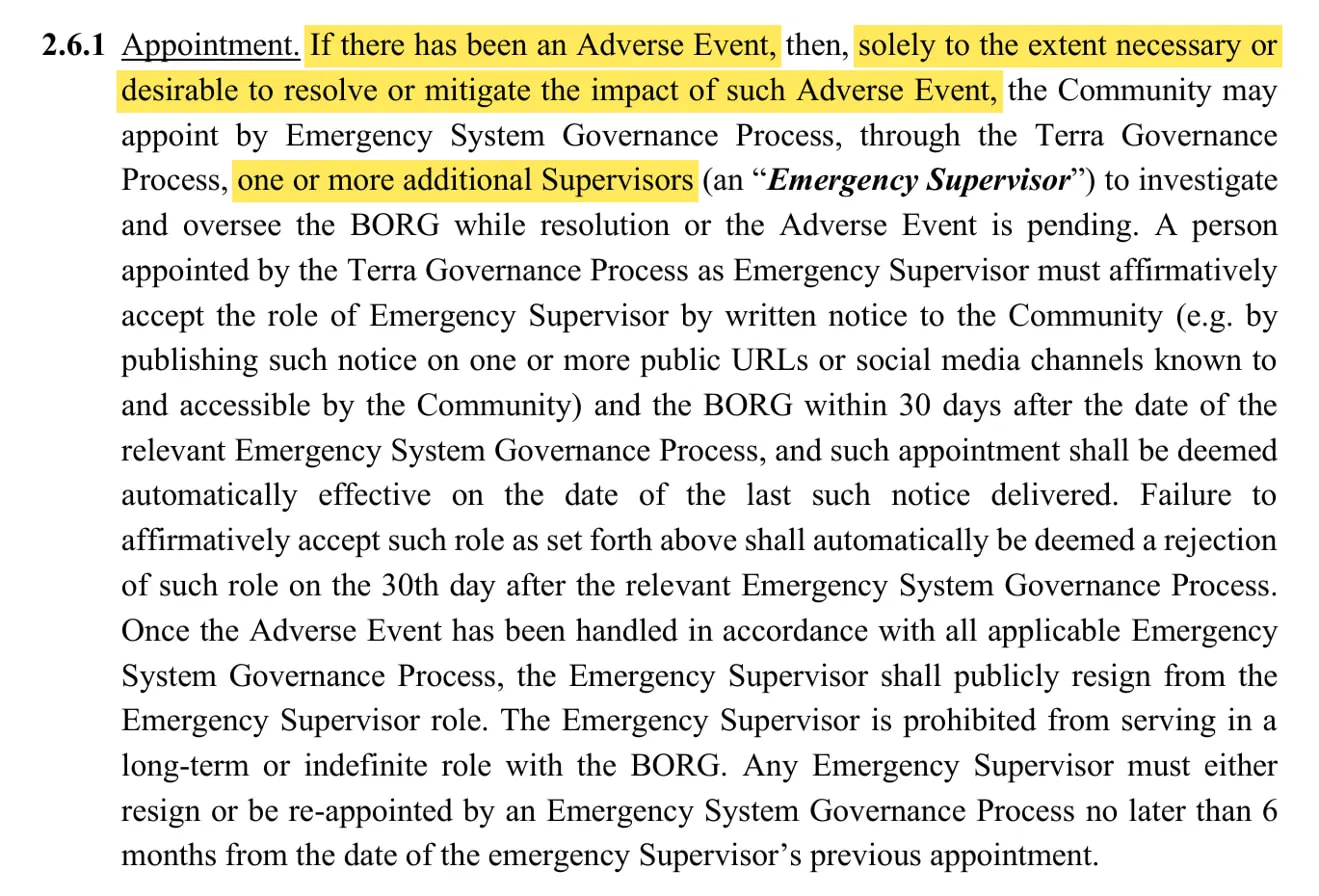
Article 2.6.1 requires an Adverse Event, not a lost vote (Bylaws, Art. 2.6.1, p. 12).
Article 2.6.1: "If there has been an Adverse Event, then, solely to the extent
necessary or desirable to resolve or mitigate the impact of such Adverse Event,
the Community may appoint by Emergency System Governance Process, through the
Terra Governance Process, one or more additional Supervisors (an 'Emergency
Supervisor') to investigate and oversee the BORG while resolution or the Adverse
Event is pending."
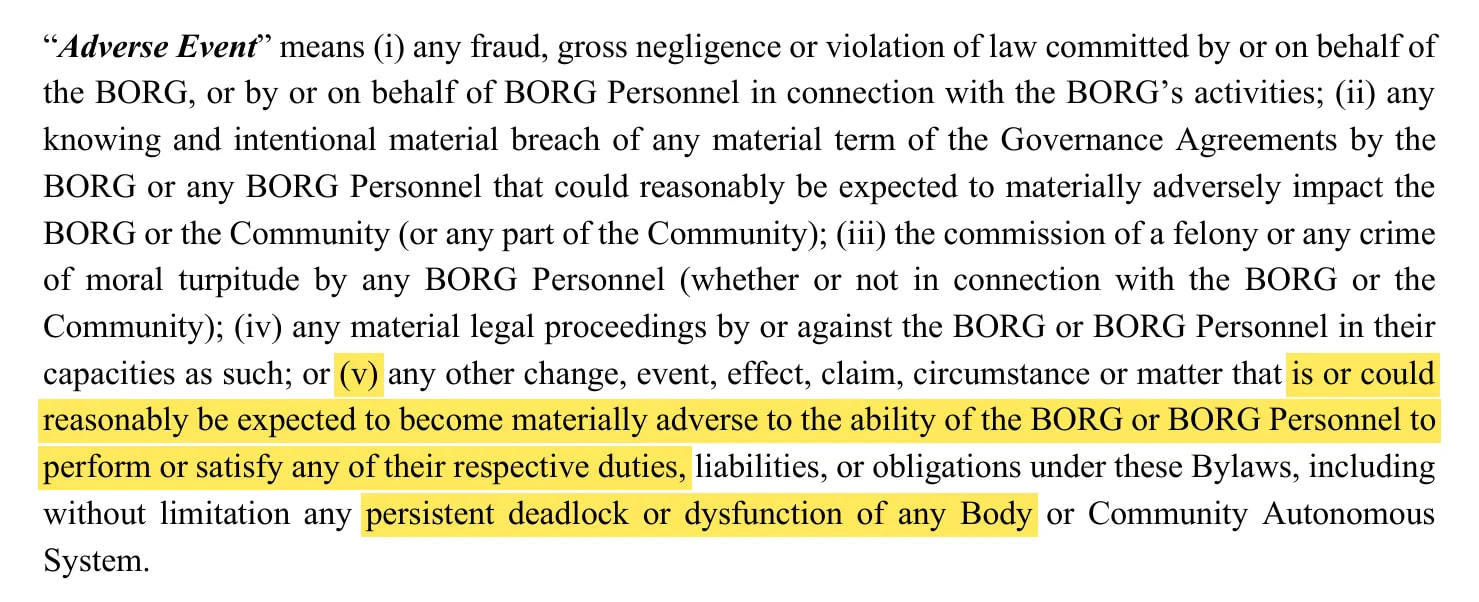
Nor is there any general mandate to address “dysfunction.” The opening post claims the Bylaws cover “circumstances where the Foundation’s governing bodies become unable to properly perform their responsibilities.” They mention dysfunction once, as an example of an Adverse Event, and only where it materially impairs the Foundation’s ability to perform its duties — the standard set in the definition of “Adverse Event” (Bylaws, p. 30). One failed vote isn’t that.
"Adverse Event" means ... (v) any other change, event, effect, claim, circumstance
or matter that is or could reasonably be expected to become materially adverse to
the ability of the BORG or BORG Personnel to perform or satisfy any of their
respective duties, liabilities, or obligations under these Bylaws, including
without limitation any persistent deadlock or dysfunction of any Body or
Community Autonomous System.
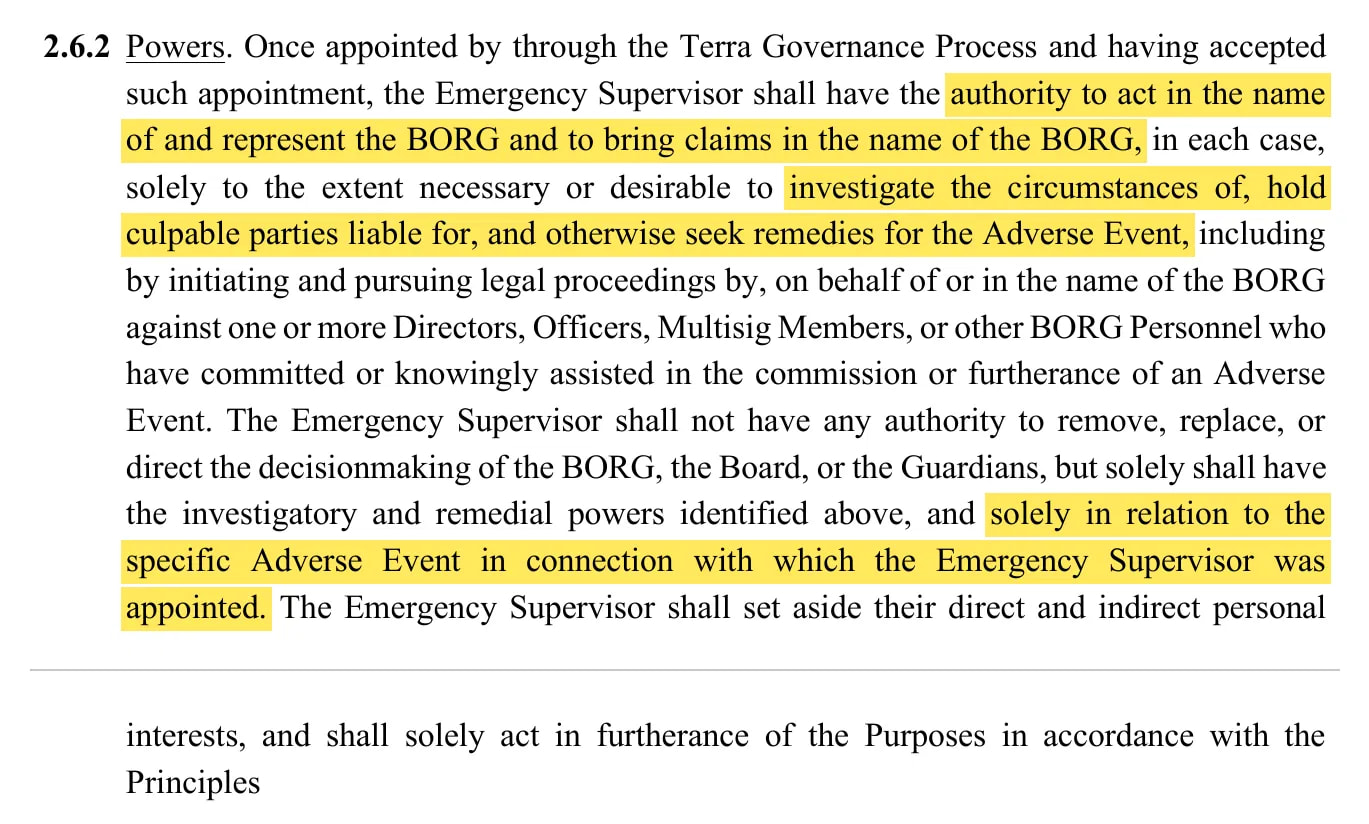
Article 2.6.2 also caps the office, barring it from removing, replacing, or directing the Board (Bylaws, Art. 2.6.2, p. 12).
Article 2.6.2: "The Emergency Supervisor shall not have any authority to remove,
replace, or direct the decisionmaking of the BORG, the Board, or the Guardians,
but solely shall have the investigatory and remedial powers identified above, and
solely in relation to the specific Adverse Event in connection with which the
Emergency Supervisor was appointed."
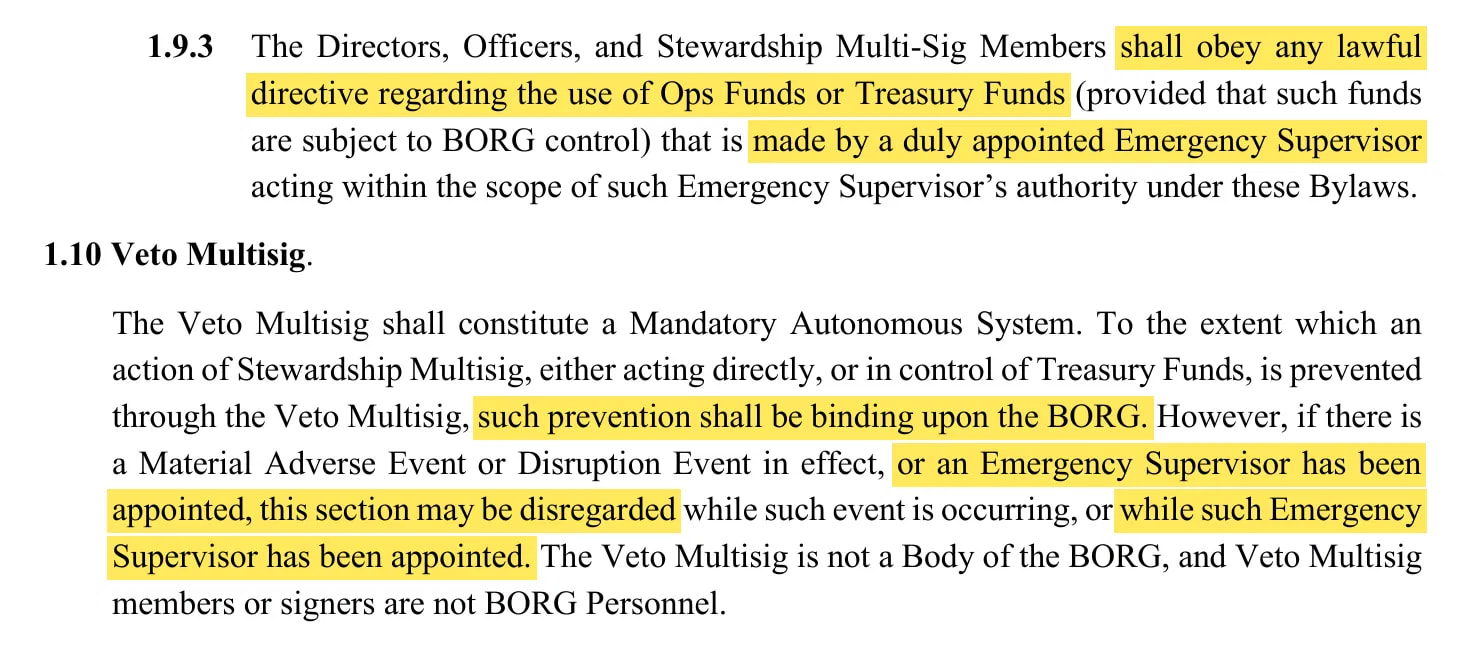
Item 4 nonetheless asks governance to authorize that removal. If the power is needed, then amend the Bylaws. As @0xPhilipp states (several times), this matter must be dealt with under the current structure. Under the current language, it cannot come through an emergency vote, and therefore must be dropped for the time being.
The voting threshold is not the problem
“The majority decides” is the rule, and the threshold was not met. A majority of four is three; A272 got two, and Board action through the multisig must also meet the multisig’s signing threshold (Bylaws, Art. 3.1.3.2, p. 15).
Article 3.1.3.2(a): "At all meetings of the Board, a majority of the total number
of Directors then in office shall constitute a quorum for the transaction of
business and the act of a majority of the Directors present at any meeting at
which there is a quorum shall be the act of the Board, except as may be otherwise
specifically provided by statute or by the Charter."

Article 3.1.3.2(c): "Notwithstanding the foregoing provisions of this Article
3.1.3.2, and for the avoidance of doubt, the Board may take no action which
requires the use of the Stewardship Multisig as a Mandatory Autonomous System
unless approved by at least the number of Directors constituting the minimum
signing threshold of the Stewardship Multisig, such approval being evidenced by
the successful execution of a Stewardship Multisig Proposal."
A272 itself needed 75% to remove a director, but fell short, so its second message lowered the threshold to 0.6. The rule was fine when it was removing a sitting director; only becoming a problem when it blocked another.
That leaves A272 doing two things at once: remove one member and drop the threshold to 0.6. Removal is only allowed by System Upgrade (Bylaws, Art. 2.4.4.1, p. 9).
Article 2.4.4.1: "A Stewardship Multisig Member may be removed from a Stewardship
Multisig solely by System Upgrade (which may occur at any time or from time to
time) causing all of the Multisig Keys of such Stewardship Multisig Member to
cease to belong to the Multisig Key Set recognized by such Stewardship Multisig,
it being acknowledged and agreed that any System Upgrade causing such removal
shall be sufficient, in and of itself to legally deem such person to have ceased
to be a member of the Stewardship Multisig as a body of the BORG."
MB has voted identically to Philipp on all 119 proposals where both voted; Rose dissenting 11 times, and Vini three. Remove Vini, cut the threshold to 0.6, and two of the remaining three pass anything without any realistic opposition. That’s not simply fixing a deadlock; it’s changing the mechanism to produce a guaranteed result on all future proposals. Vini explained it in his reply:
“A272 was more than a removal. It had two messages: removing me from the member group, and changing the PF DAO threshold to 60%. After the removal that means 2 of 3, so two directors could pass anything on their own.”
The outcome and candidates are seemingly predetermined
Item 1 establishes the Adverse Event, item 3 sets the mandate, and item 4 authorizes the removal it claims to merely investigate:
“Confirm that the Emergency Supervisor may exercise the powers available under Article 2.4.5.4, including instructing the removal of a Stewardship Multisig Member where the Supervisor determines that this is necessary or desirable to resolve the Adverse Event.” — item 4
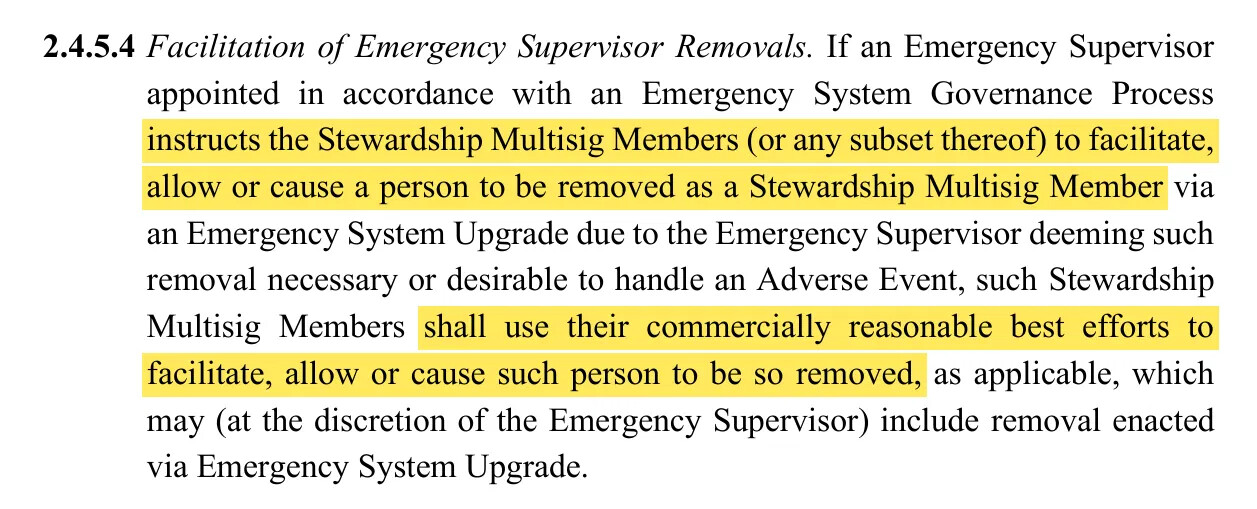
Article 2.4.5.4 obliges Stewardship members to facilitate a removal an Emergency Supervisor instructs (Bylaws, Art. 2.4.5.4, p. 10).
Article 2.4.5.4: "If an Emergency Supervisor appointed in accordance with an
Emergency System Governance Process instructs the Stewardship Multisig Members
(or any subset thereof) to facilitate, allow or cause a person to be removed as a
Stewardship Multisig Member via an Emergency System Upgrade due to the Emergency
Supervisor deeming such removal necessary or desirable to handle an Adverse Event,
such Stewardship Multisig Members shall use their commercially reasonable best
efforts to facilitate, allow or cause such person to be so removed, as applicable,
which may (at the discretion of the Emergency Supervisor) include removal enacted
via Emergency System Upgrade."
The proposal claims “both outcomes must remain possible,” yet item 4 has already authorized the removal — one specific outcome. It says “I am not asking Terra Governance to accept my assessment,” while item 1 asks governance to accept that assessment as fact. And Philipp concedes the Emergency Supervisor “cannot directly remove a Director,” then item 4 asks for the removal anyway. Every assurance of neutrality is contradicted by the proposal’s own text.
The candidates aren’t open either. The opening post presents two names already “acknowledged as potential candidates by three of the four current Stewardship Directors.” A later reply says it proceeds “with only 1” if no third candidate is found, and a later one still says other PF members “already engaged with this process and agreed with the options.” The mandate, the remedy, and the candidate pool are all settled before the community votes.
The conflict and security charges, checked against the record
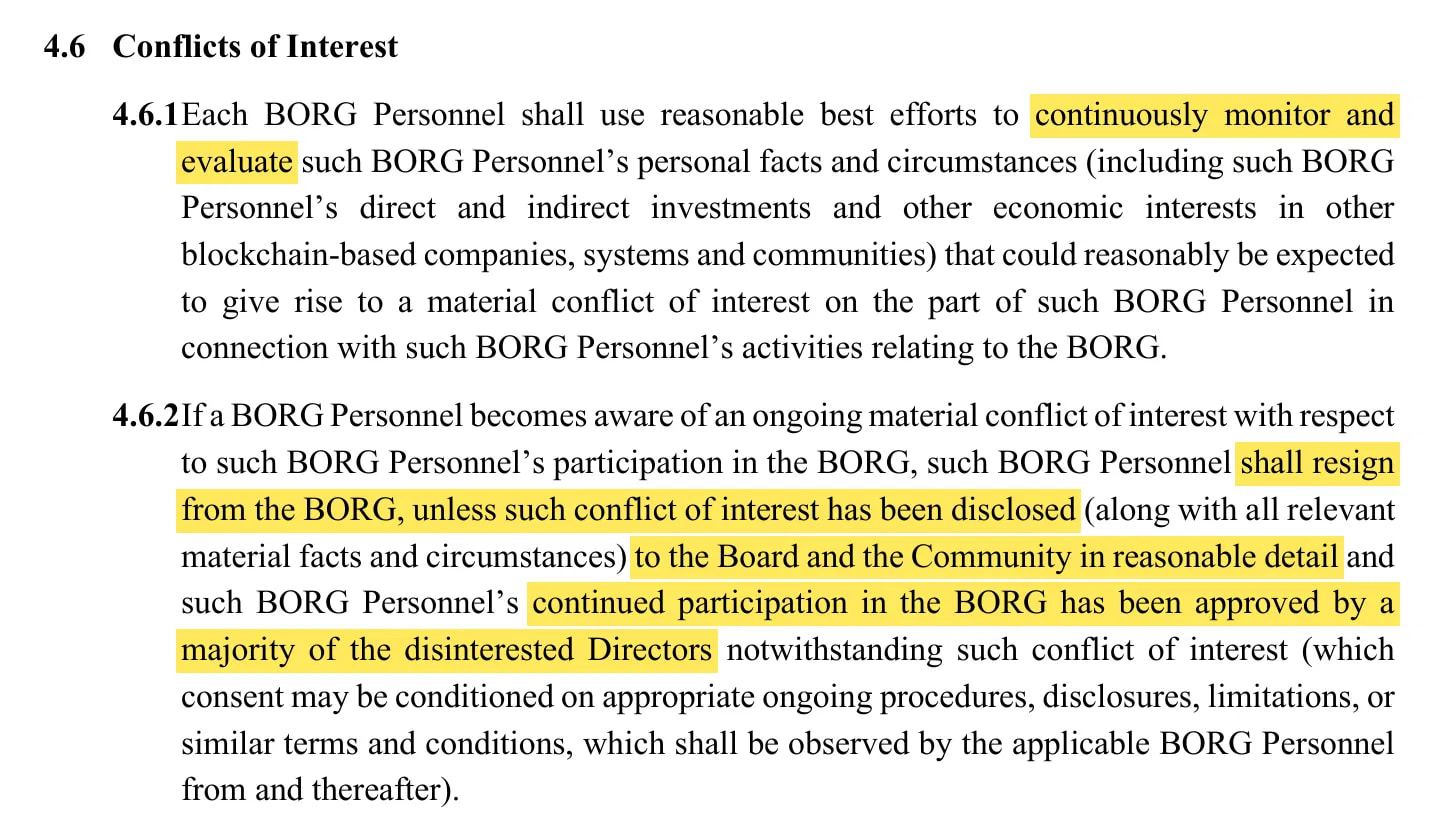
A272 attacks a director over A249, a grant that “paid his own company despite a recognized conflict.” The same record shows the accuser authoring and voting yes on at least seven proposals that paid his own address — $20,450 and 3,500 LUNA — with no on-chain record of disclosure or disinterested-director approval (Bylaws, Art. 4.6.2, p. 23; Art. 3.2.5.3, p. 20).
Article 4.6.2: "If a BORG Personnel becomes aware of an ongoing material conflict
of interest with respect to such BORG Personnel's participation in the BORG, such
BORG Personnel shall resign from the BORG, unless such conflict of interest has
been disclosed (along with all relevant material facts and circumstances) to the
Board and the Community in reasonable detail and such BORG Personnel's continued
participation in the BORG has been approved by a majority of the disinterested
Directors notwithstanding such conflict of interest."

Article 3.2.5.3: "Each Stewardship Multisig Member shall ... evaluate the merits
of each ... Proposal solely in light of the Purposes, Authorized Uses and the
Principles, and, based solely on such evaluation, and without regard to any
personal or extrinsic interest or consideration, determine whether to vote in
favor of such Proposal ..."
A272 also says written security concerns “were dismissed … potentially exposing about $4.4M,” while Philipp’s own later reply says “MB and I were the ones who identified and reported the issue and triggered the process for an immediate Neutron chain halt.” Both can’t stand unqualified. And the Bylaws impose no duty to monitor, prevent, or report security risks (Bylaws, Art. 4.4, p. 23).
Article 4.4: "Without limiting the generality of Article 4.3, none of the BORG,
Directors, Supervisors, Multisig Members or other BORG Personnel shall have any
duty to the Community or any member thereof to monitor, respond to, prevent,
mitigate, or announce any actual or perceived security threat or risk, by using
any Stewardship Multisig or otherwise."
The existing requirement for a Supervisor is being ignored
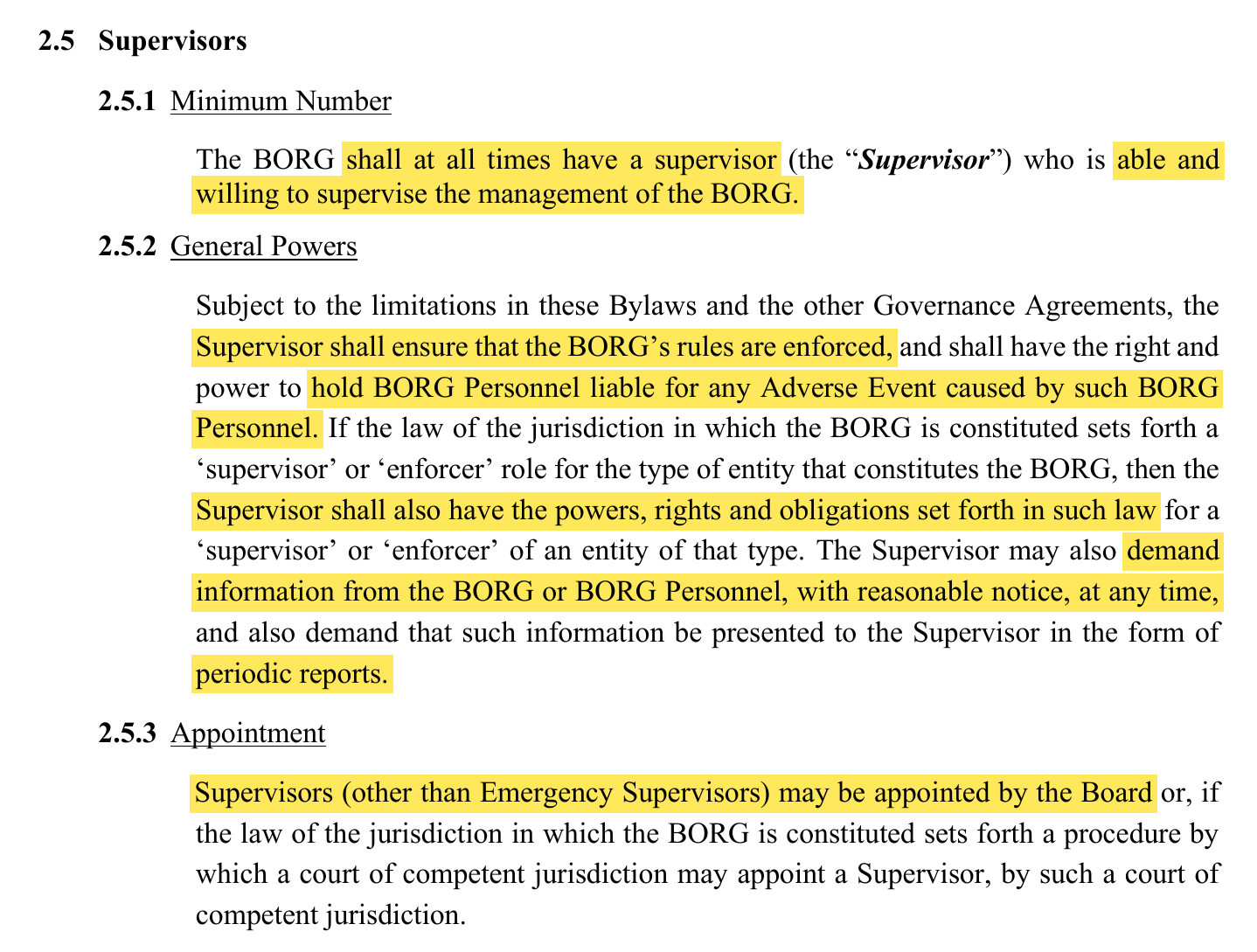
Philipp calls the missing standing Supervisor “a separate governance issue,” and says structural changes “should not be mixed into this process.” Neither holds against the text: the Bylaws require one at all times, with the power to hold personnel liable for Adverse Events (Bylaws, Arts. 2.5.1–2.5.2, p. 11).
Article 2.5.1: "The BORG shall at all times have a supervisor (the 'Supervisor')
who is able and willing to supervise the management of the BORG."

Article 2.5.2: "Subject to the limitations in these Bylaws and the other
Governance Agreements, the Supervisor shall ensure that the BORG's rules are
enforced, and shall have the right and power to hold BORG Personnel liable for
any Adverse Event caused by such BORG Personnel."
No Supervisor has been appointed, despite that “at all times” requirement. Instead the proposal sets its own clock — “maximum of four weeks,” “end of next week,” “with only 1” — while the Bylaws say the Community “may” appoint and set no deadline.
The edits and remaining arguments do not establish an Adverse Event
The remaining justifications don’t establish an Adverse Event. Mandate, contribution, meme coins, “assets on Terra,” “catastrophic liquidity loss,” “Terra Classic” — none of it meets the definition’s material-harm test, much is months old (A249 closed more than three months before A272), and alarmism isn’t an argument.
The Bylaws impose no fiduciary duty to any individual community member (Bylaws, Art. 4.2.3, p. 23).
Article 4.2.3: "As such none of the BORG, the Directors, Officers, Stewardship
Multisig Members, Supervisors, Emergency Supervisors, and other BORG Personnel
are able to, or will, accept, undertake or perform a duty of loyalty to or owe
any fiduciary obligation to any single Community member, sub-group of the
Community, or the Community as a whole."
Conclusion
This isn’t accountability, it’s one person’s personal desire for more power.
Where a rule helps, it bends: a 2–1–1 vote becomes “dysfunction” (p. 30), the power the Bylaws withhold becomes the power requested (p. 12), and the required Supervisor becomes “a separate governance issue” (p. 11). Where it doesn’t, it’s absolute — the 75% threshold is immovable for a removal and negotiable to 0.6 when it blocks one (Art. 3.1.3.2(c), p. 15); 2.4.5.4 binds while 2.6.2’s bar on that same removal is a technicality (pp. 10–12); and the materiality test that demands real harm is satisfied by one vote (p. 30). A rule is only as absolute as its convenience.
Article 2.6.2: "The Emergency Supervisor shall not have any authority to remove,
replace, or direct the decisionmaking of the BORG, the Board, or the Guardians,
but solely shall have the investigatory and remedial powers identified above, and
solely in relation to the specific Adverse Event in connection with which the
Emergency Supervisor was appointed."

"Adverse Event" means ... (v) any other change, event, effect, claim, circumstance
or matter that is or could reasonably be expected to become materially adverse to
the ability of the BORG or BORG Personnel to perform or satisfy any of their
respective duties, liabilities, or obligations under these Bylaws...

Article 2.5.1: "The BORG shall at all times have a supervisor (the 'Supervisor')
who is able and willing to supervise the management of the BORG."
Bottom line: no deadlock, no qualifying Adverse Event, no authority to remedy “dysfunction,” and none to instruct a removal. The required Supervisor was never appointed, the outcome and candidates are predetermined, and A272 pairs removing one member with cutting the threshold to 0.6 so two votes that have never differed control everything. If the question is who should sit on the Board, ask that directly — don’t relabel a 2–1–1 vote as an emergency.